
World Cup 2026 Debutants: Cabo Verde, Curaçao, Jordan and Uzbekistan — Betting Profiles
 Available in US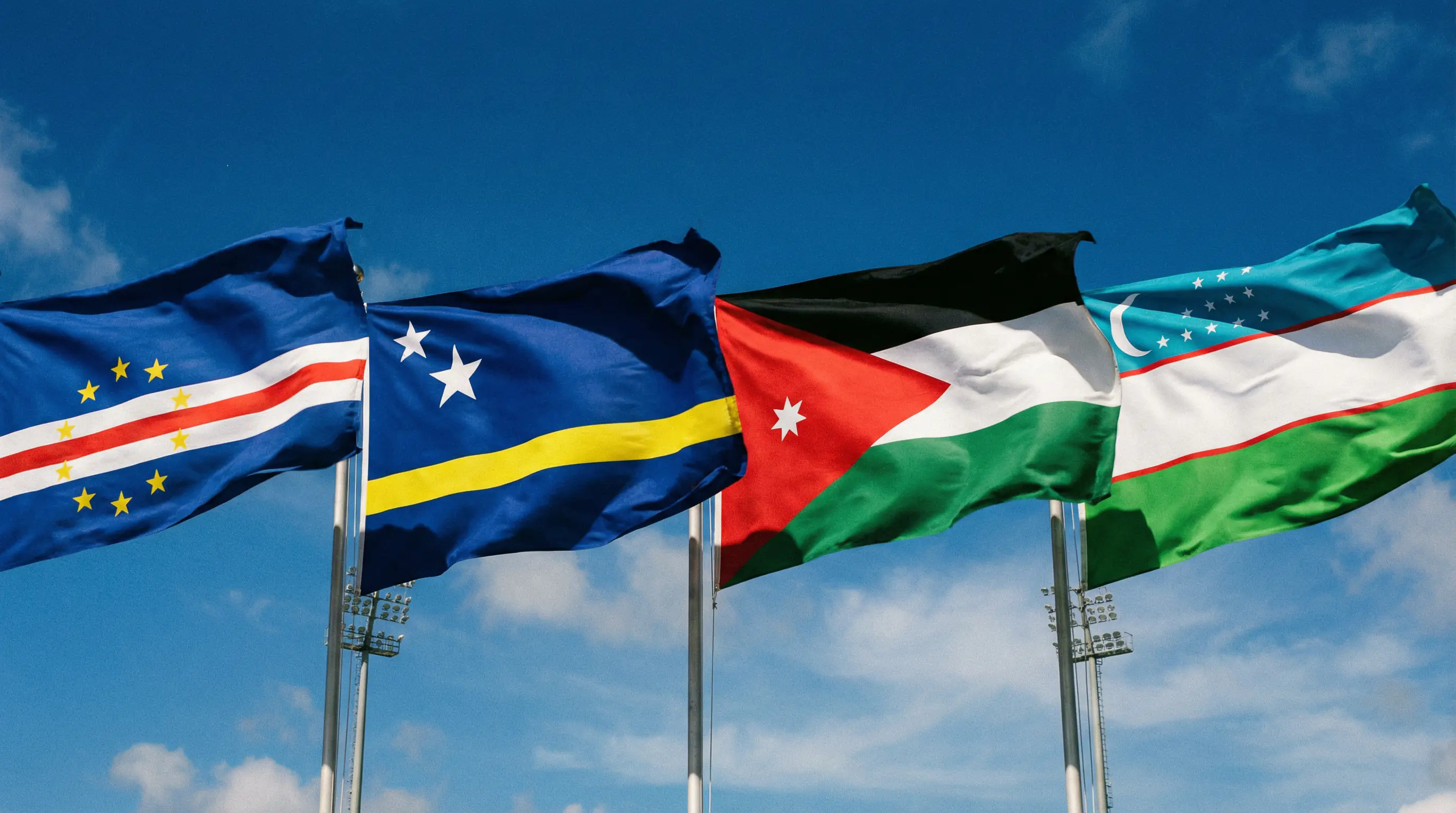
In December 2022, I watched Cabo Verde’s players collapse onto the pitch in tears after beating Nigeria on penalties. Not because they’d won a major trophy — they’d simply qualified for their first-ever Africa Cup of Nations knockout round. Fast forward to March 2026, and those same players will walk out at a FIFA World Cup. Four nations — Cabo Verde, Curaçao, Jordan, and Uzbekistan — will experience that moment for the first time in their football histories. For betting markets, these debutants present a fascinating paradox: zero World Cup data to analyse, but plenty of form from qualification campaigns that defied every prediction model.
The 48-team expansion created space for smaller federations to break through, and these four did exactly that. Each took a different path — Cabo Verde through African qualifying’s brutal group stage, Curaçao via CONCACAF’s revamped Nations League pathway, Jordan through Asia’s intercontinental playoff, and Uzbekistan by dominating their AFC group. The bookmakers have lumped them all into longshot territory, pricing each between 250.00 and 500.00 for outright winner markets. But within group stages and specific match markets, there’s genuine value hiding in the uncertainty. I’ve been covering World Cup betting for over a decade, and first-timers consistently outperform their pre-tournament odds in individual matches — the lack of big-stage baggage works in their favour more often than pundits expect.
Cabo Verde: Atlantic Islands on the World Stage
There’s a number that should terrify every team in Group H: 580,000. That’s the entire population of Cabo Verde, roughly the size of the Gold Coast. And yet here they are, preparing to face Spain, Saudi Arabia, and Uruguay in their first World Cup. The Blue Sharks qualified by finishing second in African Group I, behind Morocco but ahead of South Africa and Tanzania. Their 3-1 aggregate win over Tanzania in the final qualifying round sealed history — the smallest nation ever to reach the World Cup.
Manager Pedro Brito has built this team around one principle: defensive organisation first, everything else second. Across eight qualifiers, Cabo Verde conceded just seven goals — a record that rivalled Morocco’s defensive impermeability. Goalkeeper Vozinha, who plays for Portuguese second-tier side Estoril, made more saves per match than any other CAF qualifying keeper while maintaining the fourth-best save percentage in the confederation. The back four, anchored by captain Stopira, operated with a narrow block that frustrated opponents into long-range efforts and crosses into congested areas.
The attacking threat comes largely from Ryan Mendes, a 33-year-old winger who’s spent his career bouncing around Portuguese lower leagues but somehow turns into a different player in blue. His six assists during qualifying led all CAF players, and his ability to hold width while the team defends deep gives Cabo Verde a genuine counter-attacking threat. Júlio Tavares, another Portugal-based forward, provides physical presence that allows Mendes freedom to roam.
Betting markets have priced Cabo Verde at 4.50 to finish bottom of Group H, which seems almost generous given they’re facing Spain and Uruguay. But here’s where it gets interesting — their odds to pick up at least one point in the group stage sit around 2.20, which I consider excellent value. Saudi Arabia represent a winnable match, and the compact defensive system that worked against Morocco should translate to tournament football. The question isn’t whether Cabo Verde can compete; it’s whether their lack of depth can survive three matches in nine days.
For Aussie punters looking at Cabo Verde markets, the player specials offer the most intrigue. Mendes to record an assist in any group match is priced around 5.00 at most bookmakers — given he averaged 0.75 assists per qualifier and faces Saudi Arabia’s occasionally vulnerable right side, that’s a bet worth considering.
Curaçao: Caribbean Flair Meets FIFA’s Biggest Tournament
Watch Curaçao play for ten minutes and you’ll notice something Australian football rarely produces: genuine technical joy. There’s a rhythm to their passing that feels closer to Dutch football than Caribbean — and for good reason. The island’s colonial history means most talented players develop through Dutch academies, and the current squad features ten players with Eredivisie experience. When Guus Hiddink took over as technical advisor in 2024, he didn’t need to impose a European tactical framework — the players already thought in Dutch football’s language.
The qualification campaign told a story of steady improvement rather than breakthrough moments. Curaçao finished second in CONCACAF’s Nations League B, earning playoff berths that culminated in a dramatic penalty shootout win over Guatemala. Goalkeeper Eloy Room, a veteran of the Eredivisie who’s spent seasons at PSV and Vitesse, saved two penalties to send the island of 150,000 inhabitants to their first World Cup. Room remains the heartbeat of this team at 35 — his experience across European football’s pressure moments provides a calming presence that debutant nations typically lack.
Manager Dick Advocaat — yes, the same Advocaat who managed the Netherlands, South Korea, and Russia at World Cups — has installed a pragmatic 4-2-3-1 that prioritises ball retention in midfield. The engine room pairing of Leandro Bacuna (formerly of Aston Villa and Cardiff) and Michaël Maria gives Curaçao a Championship-level midfield core. Up front, Rangelo Janga leads the line with the physical presence to hold the ball against bigger opponents, while Kenji Gorré provides pace on the counter.
Curaçao landed in Group E alongside Germany, Côte d’Ivoire, and Ecuador — a brutal draw that left bookmakers pricing them at 1.45 to finish bottom. Germany’s group-stage woes over the past two World Cups offer a sliver of hope, but Côte d’Ivoire and Ecuador both represent stern tests. The realistic goal is competitive performances rather than points, and the betting angles reflect this.
Where value exists is in the goal markets. Curaçao scored in seven of eight qualifiers, suggesting they’ll at least threaten against Ecuador and potentially Germany. The odds on Curaçao to score in all three group matches sit around 6.00 — ambitious, certainly, but their attacking organisation and Janga’s aerial presence give them a chance in every match. For a more conservative approach, “Curaçao to score in at least one group match” at 1.65 represents reasonable value given their qualifying form.
Jordan: Asia’s Newest World Cup Nation
Twenty-three seconds. That’s how long it took Jordan to score against Bolivia in the intercontinental playoff first leg — the fastest goal in World Cup playoff history. Yazan Al-Naimat buried the chance to silence La Paz’s altitude advantage before anyone had settled into their seats. Jordan won 2-0 away and completed a 4-1 aggregate victory to seal their first World Cup, just three months after winning their first-ever Asian Cup.
The 2024 Asian Cup transformed Jordanian football’s global perception. Hussein Ammouta’s side reached the final by beating South Korea and Iraq in knockout rounds, playing a counter-attacking style that exposed Asian heavyweights’ tactical naivety. They lost the final 3-1 to Qatar, but the tournament proved something valuable: Jordan can compete with Asia’s best when the stakes are highest. That psychological barrier — believing they belonged at elite level — had held Jordanian football back for decades.
The squad features an unusual blend of local league players and Gulf-based professionals, with only goalkeeper Yazeed Abu Laila playing in Europe (Polish second division). This gives Jordan a cohesion that expatriate-heavy squads often lack — most players see each other regularly in the Jordanian Premier League or cross-border competitions. Captain Mousab Bataineh marshals the defence from centre-back, while Al-Naimat’s pace stretching defences creates space for playmaker Yazan Abu Arab to operate between the lines.
Group J pairs Jordan with Argentina, Algeria, and Austria. The defending champions represent an obvious mismatch, but Algeria and Austria are both beatable on Jordan’s day. The odds reflect this nuance — Jordan to finish third in Group J is priced around 3.20, acknowledging that one or two results could see them through as a best third-placed team. With eight third-placed teams advancing from twelve groups, Jordan’s path to the knockout rounds is far from impossible.
The intercontinental playoff victory over Bolivia demonstrated something bookmakers haven’t fully priced in: Jordan performs better as underdogs. Their Asian Cup run came with minimal expectation, and the playoff atmosphere — hostile altitude, 40,000 Bolivian supporters — failed to intimidate a squad conditioned by regional football’s unpredictability. At the World Cup, Jordan will enter every match as underdogs, exactly where Ammouta’s system thrives.
For betting purposes, Jordan’s goal markets offer the best value. Over 1.5 goals in Jordan’s group matches combined is priced around 1.55 — given they scored four against Bolivia and averaged 1.8 goals per match through Asian qualifying, this seems underpriced. Al-Naimat to score anytime in the tournament sits around 4.00, and his pace could trouble Austria’s aging centre-back pairing.
Uzbekistan: Central Asian Football Arrives
The White Wolves don’t do things quietly. Uzbekistan qualified for the World Cup with four matches to spare, the earliest any Asian nation has clinched their spot. Their Group A campaign produced eight wins from ten matches, 25 goals scored, and just four conceded. Where Japan and South Korea often struggle for consistency in Asian qualifying, Uzbekistan treated the competition like a procession — their 8-0 demolition of Kuwait was the joint-highest margin in Asian World Cup qualifying history.
Manager Srecko Katanec has been building toward this moment since 2021. The former Slovenian international installed a pressing system that suits Uzbekistan’s technically gifted midfielders, and the current squad represents the first generation to mature entirely under his philosophy. The spine of the team — goalkeeper Otabek Shukurov, centre-back Abdukodir Khusanov, and captain Eldor Shomurodov — all play in Europe’s top five leagues, giving Uzbekistan a tactical sophistication that previous generations lacked.
Shomurodov deserves particular attention. The 29-year-old Roma striker scored eight goals during qualifying, including a hat-trick against Kuwait and crucial strikes against Iran. He’s spent seasons at Genoa and Bologna, accumulating Serie A experience that few Asian forwards possess. His movement in the box and ability to finish from tight angles make him Uzbekistan’s primary threat — and one that European opponents might underestimate.
Uzbekistan landed in Group K with Portugal, DR Congo, and Colombia. The draw looks brutal on paper, but Katanec’s side earned their place by dismantling teams that tried to dominate possession against them. Portugal’s meticulous build-up play could leave spaces for Uzbekistan’s transitions, while DR Congo and Colombia both suffered defensive lapses during their respective qualifying campaigns.
The odds on Uzbekistan to qualify from Group K sit around 4.50 — aggressive, certainly, but not outlandish given their qualifying form. A more measured approach looks at their match against DR Congo, where Uzbekistan’s European experience and tactical discipline should create a competitive contest. Uzbekistan to win that match is priced around 3.50, which represents genuine value if Katanec’s side arrives in similar form to qualification.
For Aussie punters familiar with the A-League, Uzbekistan offers one particularly interesting market. Several of their fringe players have spent time in Australian football — former Adelaide United forward Ulugbek Hoshimov briefly trained with the squad before falling out of favour. The cultural exchange between Asian federations means Uzbekistan’s style won’t feel entirely foreign to Socceroos supporters watching their matches, and their organised approach to counter-attacking football echoes what Graham Arnold deployed during Australia’s successful qualifying campaign.
Debutant Betting: Where Longshot Value Hides
Sixteen nations have made their World Cup debuts since the tournament expanded to 32 teams in 1998. Of those, five reached the knockout rounds — Senegal (2002), Ukraine (2006), Slovakia (2010), Bosnia and Herzegovina (2014), and Iceland (2018). That’s a 31% conversion rate, far higher than pre-tournament odds typically suggested. The pattern reveals something markets consistently undervalue: debutants arrive without the psychological baggage of previous World Cup failures.
Iceland’s 2018 campaign perfectly illustrated this phenomenon. Priced at 200.00 for outright winner markets, they held Argentina to a 1-1 draw in their opening match and came within fifteen minutes of beating Croatia. Their players had nothing to lose and everything to gain — the same mentality that drove Jordan to an Asian Cup final and Cabo Verde through African qualifying’s chaos.
The four 2026 debutants share another characteristic that betting models struggle to capture: manager stability. Cabo Verde’s Pedro Brito has been in charge since 2021. Jordan’s Hussein Ammouta built the Asian Cup squad over two years. Uzbekistan’s Srecko Katanec has worked with the same core players since 2021. This continuity produces tactical cohesion that even nominally stronger nations can lack — consider England’s constant managerial churn or Germany’s recent identity crisis.
The group stage accumulator market offers the most attractive debutant bet. All four nations to pick up at least one point each in the group stage is priced around 12.00 at most bookmakers. Individually, those odds suggest roughly 50% probability per team — but collectively, the shared characteristics of defensive organisation, manager stability, and underdog mentality make this a bet worth considering at those prices.
Player markets provide another angle. The four debutant nations feature several players with European experience who’ve been anonymous in their domestic leagues but dominant in qualifying. Jordan’s Al-Naimat, Uzbekistan’s Shomurodov, Cabo Verde’s Mendes, and Curaçao’s Janga all represent anytime scorer value in the 4.00-6.00 range for individual group matches. Tournament-level football exposes defensive gaps that domestic leagues often don’t, and these forwards have proven they can finish against organised defences.
One market I’d avoid entirely: outright winner bets on any debutant. The pricing — 250.00 to 500.00 across the four — looks attractive until you remember that even Iceland’s historic 2018 run ended in the group stage. The value lies in match-specific and group-specific markets where debutant overperformance historically occurs, not in the seven-match tournament run required for outright glory.
Four Flags Fly for the First Time
When these four nations walk out for their opening World Cup matches, they’ll carry the dreams of populations that range from 150,000 (Curaçao) to 36 million (Uzbekistan). The gulf in resources, history, and expectations couldn’t be wider — yet all four arrive having qualified through legitimate, demanding campaigns that tested every aspect of their football programmes.
For Australian punters, the debutants offer something our own World Cup 2026 teams coverage rarely provides: genuine uncertainty. The Socceroos have World Cup history, European-based stars, and decades of tournament data. These four nations operate in betting’s blind spot, where value emerges from the gap between perception and performance.
The 48-team format created space for these stories, and the stories are just beginning. Whether it’s Cabo Verde’s population ratio miracle, Curaçao’s Dutch coaching renaissance, Jordan’s psychological breakthrough, or Uzbekistan’s Central Asian dominance, each debutant brings something unique to North American pitches. The bookmakers have priced them as cannon fodder. History suggests they’ll be something more interesting than that.
