
South Korea at the World Cup 2026: Odds, Squad and Group A Preview
 Available in US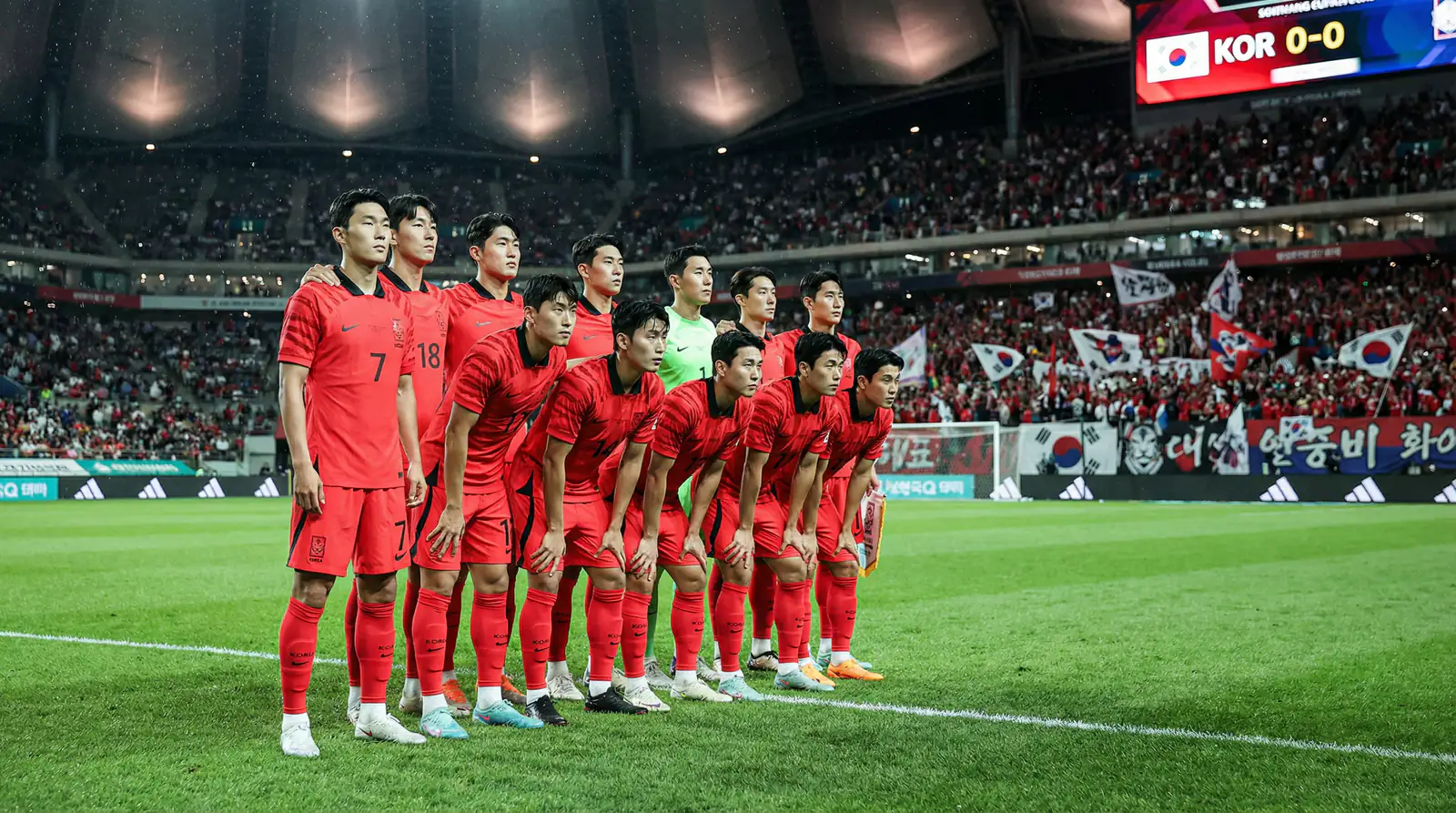
Son Heung-min will be 33 when the 2026 World Cup begins. That single fact frames everything about South Korea’s tournament — is this the last chance for the most gifted Korean footballer of his generation to deliver a deep run, or has the window already closed? For Aussie punters who have watched Son torture Socceroos defences across multiple AFC qualifying campaigns, the answer matters. South Korea’s odds, their Group A draw, and Son’s availability shape one of the more intriguing second-tier betting propositions at the tournament.
South Korea’s AFC Qualifying Campaign
Like Japan, South Korea navigated AFC qualifying with the confidence of a side accustomed to World Cup football. They have appeared at every tournament since 1986 — eleven consecutive World Cups — and the qualifying pathway held no surprises for a squad that treats passage to the finals as a baseline expectation rather than an achievement.
South Korea finished in the top two of their third-round qualifying group, securing automatic qualification without the stress of the inter-confederation play-off. The campaign featured dominant home performances in Seoul, where the Red Devils’ fanbase created an atmosphere that visiting sides found overwhelming, and competent away results that accumulated the points needed well before the final matchday.
The qualifying statistics reveal a side that is solid rather than spectacular. South Korea scored enough goals to win matches comfortably at home but struggled to break down well-organised defences away from Seoul. The away record — a mix of draws and narrow wins — suggests a squad that can be contained by sides willing to sacrifice possession and defend deep. That pattern is relevant for Group A opponents, particularly Mexico, who will have the crowd advantage as co-hosts.
The Socceroos’ matches against South Korea in qualifying were competitive, closely fought affairs that reflected the rivalry between the two nations. Australia’s defensive structure frustrated South Korea’s attacking patterns, and the Korean inability to dominate a well-organised mid-block is a recurring theme that Group A opponents will study. For punters who watched these contests, the assessment is clear: South Korea are good, but they are beatable when opponents refuse to engage in open football.
Key Players: Son and Beyond
Son Heung-min’s importance to South Korea cannot be overstated — and that is both a strength and a vulnerability. At Tottenham Hotspur, Son has scored over 160 Premier League goals, establishing himself as one of the most prolific Asian players in the history of European football. His pace, left-foot finishing, and ability to create chances from wide positions or through the centre make him the focal point of every Korean attack.
The concern is age and mileage. By June 2026, Son will have played over a decade of Premier League football — one of the most physically demanding leagues in the world. The explosive acceleration that defined his peak years has gradually diminished, and while his football intelligence compensates, the player who terrified Socceroos defenders in 2019 is not quite the same player who will take the pitch in 2026. For punters, Son’s fitness reports in May and early June will be critical. If he arrives at the World Cup fresh and fully fit, South Korea’s odds shorten meaningfully. If he carries any physical concern, the impact on the squad’s attacking output is disproportionate.
Beyond Son, the squad has developed genuine depth in recent years. Lee Kang-in at Paris Saint-Germain provides creative quality from midfield — his vision, passing range and set-piece delivery give South Korea an alternative playmaker who can produce moments of individual brilliance. Hwang Hee-chan’s pace and directness on the flanks add a dimension that stretches defences horizontally. Kim Min-jae’s defensive authority — honed at Napoli and Bayern Munich — provides the foundation at the back.
The generational transition is the subtext of this World Cup campaign. Son represents the old guard — the player who carried Korean football on his shoulders for a decade. Lee, Hwang and a cohort of younger players represent the future. How the squad balances Son’s experience and declining physical peak with the energy and ambition of the next generation will determine whether South Korea progress from Group A or exit at the first hurdle.
Group A: Mexico, South Africa, Czechia — South Korea’s Draw
Group A is the opening group of the tournament, with co-hosts Mexico playing the first match of the World Cup against South Africa at the Estadio Azteca on 11 June. That match sets the emotional tone for the entire tournament, and South Korea must navigate its aftermath — the energy, the media attention, and the crowd dynamics of a group that includes a host nation playing in one of the most iconic stadiums in football history.
Mexico at home in Mexico City is the toughest fixture South Korea face. The Azteca’s altitude — 2,240 metres above sea level — affects visiting sides physically, reducing stamina and recovery rates. The crowd noise, the partisan atmosphere, and the weight of a nation expecting their co-hosted World Cup to begin with a statement create conditions that few visiting teams can overcome. South Korea’s recent record against CONCACAF opposition is mixed, and a match against Mexico at the Azteca is a different proposition from facing them at a neutral venue.
South Africa bring physical athleticism and home-continent experience from 2010, where they became the first host nation eliminated in the group stage. The current squad has rebuilt through a generation of players competing in the South African Premier Division and European lower leagues, and their qualification through CAF was earned through defensive organisation rather than attacking flair. South Korea should handle South Africa with the quality advantage they possess, but complacency against an African side at a World Cup is a well-documented recipe for shock results.
Czechia qualified through the UEFA play-offs, beating Ireland and Denmark in a run that demonstrated resilience and tactical discipline. Their squad blends Bundesliga and Serie A experience with Czech First League players who bring familiarity with the national team’s pressing system. Czechia are competitive without being elite — the kind of opponent South Korea should beat but may struggle against if the match becomes a physical, low-tempo contest that neutralises Korean technical superiority.
The group winner market prices Mexico as favourites at around 2.00-2.40, with South Korea second at 3.00-3.80. That spread reflects the home advantage Mexico carry at the Azteca and across the tournament, but South Korea’s quality means the gap between first and second is narrower than the odds suggest. If Mexico stumble against South Africa or Czechia, South Korea could top the group — and the price for that outcome offers value.
South Korea Betting Odds: Group and Outright
South Korea’s outright World Cup winner odds sit at approximately 51.00-81.00, placing them alongside Turkey and several European second-tier nations in the market hierarchy. The implied probability at 67.00 is roughly 1.5% — a reflection that South Korea can compete at the group stage and potentially reach the Round of 16 or Round of 32, but are unlikely to progress deeper against elite European or South American opposition.
The value for Aussie punters lies in the group stage markets. South Korea to qualify from Group A is priced around 1.70-2.00, which represents a bet on their quality being sufficient to finish in the top two or as a best third-placed team. Given the group composition — Mexico are the only clearly superior side, and South Africa and Czechia are beatable opponents — that qualification price looks reasonable.
The South Korea vs Mexico match market is where the most significant betting opportunity sits. If you believe South Korea can take a point from Mexico — either through a draw at the Azteca or through a second group match at a more neutral venue — the draw price in that fixture will be generous enough to justify a measured bet. South Korea’s organisation and Son’s ability to produce a moment of individual quality make them a genuine threat in any single match, regardless of the venue.
The anytime goalscorer markets for Son Heung-min across the group stage offer a recurring betting angle. His pricing — typically around 2.50-3.00 per match — reflects both his quality and the recognition that he is the primary goal threat. Against South Africa and Czechia, those odds are fair to slightly short. Against Mexico, Son at a longer price could represent value if South Korea create counter-attacking opportunities against a Mexican side pushing forward at home.
An AFC Rival Aussie Punters Know Well
The Socceroos-South Korea rivalry is one of Asian football’s defining contests. From the 1997 World Cup qualifier that Australia lost in heartbreaking fashion to the modern era where the two sides contest every AFC qualifying cycle, there is history between these nations that goes beyond the pitch. For Australian punters, that history provides context that casual observers lack.
South Korea’s playing style against the Socceroos has been consistent across multiple cycles: high pressing in the first half, territorial dominance through midfield, and a reliance on Son to produce the decisive moment. When that pressing is matched — as the Socceroos have managed in recent qualifying matches — South Korea become frustrated and revert to long-range efforts and speculative crosses that well-positioned defenders can handle.
At the World Cup, South Korea’s pressing intensity will be tested against fresher opponents who have not endured the physical grind of AFC qualifying. Mexico’s technical ability to play through a press, combined with the altitude advantage at the Azteca, could nullify South Korea’s primary attacking mechanism. If the pressing fails, South Korea need a Plan B — and historically, that alternative has been to give Son the ball and hope for magic. That approach has a success rate of roughly 30-40% at the highest level, which is enough to produce occasional highlights but not enough to consistently advance past the group stage.
For Aussie punters who have watched South Korea across multiple qualifying campaigns, the honest assessment is that they are a solid but limited side at the World Cup level. Good enough to qualify from most groups, capable of a single outstanding result against a top-tier opponent, but lacking the squad depth and tactical flexibility to sustain a deep run. Their odds reflect this assessment accurately, and the value lies in the specific group stage markets where South Korea’s predictable strengths and weaknesses create definable betting opportunities.
Korea’s Red Wave heads to North America with Son leading what may be his final World Cup charge. For Aussie punters who know the Taeguk Warriors through years of AFC competition, the World Cup 2026 team profiles tell a familiar story — quality, resilience and a ceiling defined by squad depth. Group A is navigable, the odds are fair, and the specific match markets offer opportunities for punters who understand how South Korea operate under tournament pressure.
