
World Cup 2026 Groups: Draw Results, Analysis and Betting Odds for Aussie Punters
 Available in US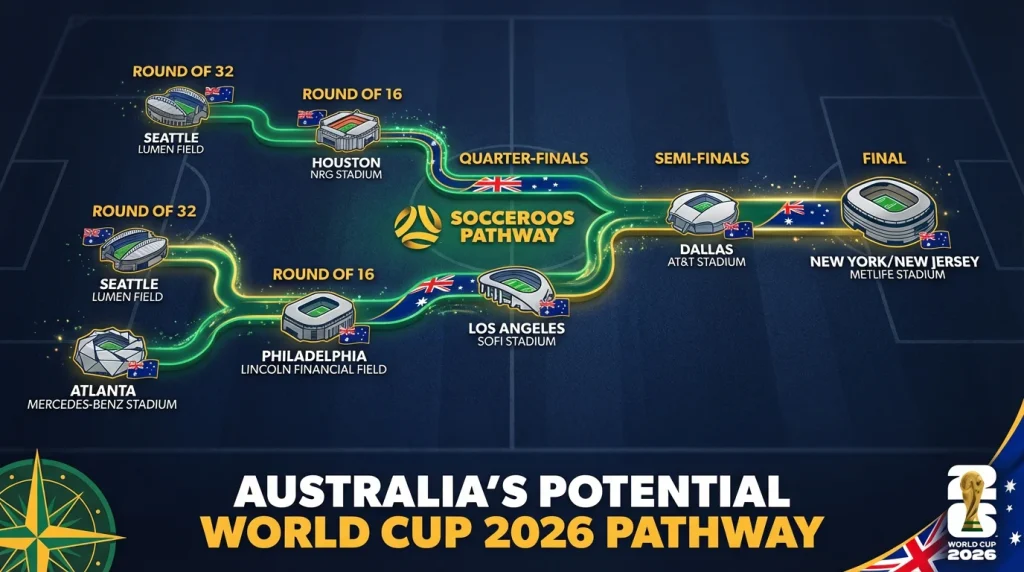
When the draw was made, I pulled up the bracket on my phone, scrolled straight to Group D, and let out a breath I didn’t know I’d been holding. USA, Paraguay, Australia, Turkey. Not a group of death. Not a free pass. Something in between — a group where the Socceroos have genuine agency over their own fate. That’s all you can ask for at a World Cup draw, and it’s more than Australia has received at several previous tournaments.
But Group D is only one of 12 stories playing out across the 2026 FIFA World Cup group stage, and for Aussie punters looking to bet across the tournament, understanding all 12 groups is essential. The draw produced everything: a group with the defending champions and a debutant (Group J), a potential group of death featuring England and Croatia reuniting eight years after their 2018 World Cup semi-final (Group L), and several groups where the outcome is so unpredictable that bookmakers have offered near-identical odds on three of the four teams. This is the full breakdown — every World Cup 2026 group, every key matchup, and the betting angles that matter.
How the Group Stage Works: 12 Groups, 32 Qualifiers
The 2026 group stage features 12 groups of four teams. Each team plays three matches — one against every other team in their group — under the standard points system: three points for a win, one for a draw, zero for a loss. The top two teams from each group advance directly to the Round of 32, and the eight best third-placed teams across all 12 groups join them. That gives us 32 knockout qualifiers from 48 teams, meaning two-thirds of the field survives the group stage.
Tiebreakers within groups follow FIFA’s standard hierarchy: goal difference, goals scored, head-to-head result, then fair play points. For the best third-place comparison across groups, FIFA uses points, then goal difference, then goals scored. Understanding these tiebreakers matters for late group-stage betting — the final matchday of each group often produces scenarios where goal difference determines advancement, and bookmakers price “team X to qualify” markets based on these permutations.
Group D: Socceroos, USA, Paraguay and Turkey — The Full Breakdown
No Australian punter needs convincing that Group D is the most important group at the 2026 World Cup. It’s the one with our team in it, and everything else is secondary until the Socceroos’ fate is decided. But beyond the patriotic lens, Group D is genuinely one of the most balanced groups in the draw — four teams ranked between 15th and 50th in the world, no obvious whipping boy, no overwhelming favourite (though the USA come close given home advantage), and three matches that could all be decided by a single goal.
The United States are the group favourites by virtue of hosting. History supports this — every host nation since 1998 has topped their group except South Africa in 2010 (who still advanced as a second-place finisher). The USMNT’s squad has been purpose-built for this moment, with a core of players in their mid-twenties who were teenagers when the hosting rights were awarded. Christian Pulisic, Weston McKennie, Tyler Adams, and Yunus Musah form a midfield-forward unit that’s played together in competitive football for half a decade. Their weak spot is central defence, where the depth drops off sharply behind the first-choice pairing.
Turkey qualified through the UEFA playoffs, beating Romania and then Kosovo 1-0 in tight, tense affairs. They’re a team built on midfield control — Hakan Calhanoglu dictates tempo from deep, while Arda Güler provides creative flair in the final third. Turkey’s challenge at World Cups has always been consistency; their famous 2002 semi-final run was followed by a failure to qualify for four of the next five tournaments. They’re capable of beating anyone on their day and losing to anyone the next. For punters, that volatility makes Turkey fascinating in match result markets but unreliable in group winner or qualification bets.
Paraguay bring CONMEBOL resilience — a polite way of saying they’re incredibly hard to beat and not particularly fun to watch. Their qualifying campaign featured more draws than wins, and their defensive record was among the best in South American qualifying. Gustavo Alfaro’s side won’t overwhelm the Socceroos with attacking talent, but they’ll make every match physical, contested, and tight. Australia’s third group match against Paraguay has “1-0 either way” written all over it.
Group D Schedule in AEST
All three Socceroos matches take place on the US west coast, which is the best possible outcome for Australian fans and punters working around AEST.
| Date | Match | Venue | AEST Kick-Off |
|---|---|---|---|
| 14 June (Sat) | Australia vs Turkey | BC Place, Vancouver | ~2:00 PM |
| 19 June (Thu) | USA vs Australia | Lumen Field, Seattle | ~5:00 AM |
| 25 June (Wed) | Paraguay vs Australia | Levi’s Stadium, San Francisco | ~12:00 PM |
The opener against Turkey on a Saturday afternoon AEST is the standout scheduling gift — expect every pub and club screening football in Australia to be packed. The USA match at 5:00 AM AEST on a Thursday is the toughest viewing commitment, but Thursday mornings have a way of becoming sick days when the Socceroos are involved. The Paraguay match at midday on a Wednesday is perfectly timed for a lunch-break viewing session. SBS broadcasts all three matches free-to-air and on SBS On Demand.
Group D Odds and Value Picks
The detailed Group D analysis goes deeper into match-by-match odds, but here’s the top-level picture. The USA are priced around 1.90 to 2.10 to top Group D. Australia and Turkey are broadly level as second favourites, typically between 3.00 and 4.00 to win the group. Paraguay are the outsiders at 5.00 to 7.00.
The value, in my assessment, sits in two specific markets. First, Australia to qualify from the group (finish top two or as a best third-placed team) — this market is typically priced around 1.80 to 2.00, which implies a 50-55% probability. I’d put the actual probability closer to 60%, given the strength of the squad, the favourable scheduling, and the third-place safety net that didn’t exist at previous World Cups. Second, the Turkey vs Australia opener has potential value on an Australia win at around 2.60 to 2.80. Turkey’s playoff qualification route means they’ve played high-pressure matches recently, but it also means they’ve had less preparation time and carry the fatigue of extra competitive fixtures.
Groups A-C: Mexico’s Opener, Canada’s Test, Brazil’s Path
The tournament kicks off in Group A, and it kicks off in style. Mexico face South Africa at Estadio Azteca in Mexico City on 11 June — the opening match of the 2026 World Cup. The Azteca hosting a World Cup opener for the third time (after 1970 and 1986) is a piece of football history, and Mexico will be desperate to set the tone in front of a crowd that can make international friendlies feel like cup finals. Group A also includes South Korea and Czechia (who qualified by beating Ireland and Denmark through penalties in the UEFA playoffs). Mexico and South Korea are the expected qualifiers, but Czechia’s playoff pedigree and South Africa’s improving trajectory make this a group where no result should surprise punters. Group winner odds favour Mexico at around 2.20, with South Korea at 2.80.
South Korea’s presence in Group A adds a subplot that Aussie punters who follow AFC qualifying will appreciate. Son Heung-min, at 33, is likely playing his final World Cup, and the desire to deliver a legacy-defining tournament performance will drive this team beyond what their squad list might suggest. South Korea have a habit of rising to World Cup occasions — the 2002 semi-final on home soil, the shock win over Germany in 2018 — and their disciplined tactical structure makes them awkward opponents. The second qualifying spot looks like a toss-up between South Korea and Czechia, and match result markets for their head-to-head fixture could offer punting value.
Group B is Canada’s tournament baptism as hosts. Switzerland, Qatar, and Bosnia and Herzegovina (who produced the playoff shock of the qualifying cycle by eliminating Italy on penalties) complete the group. Switzerland are the steady favourites — a team that always qualifies and always competes without ever threatening to win the tournament. Their squad is built on Bundesliga and Premier League experience, with Granit Xhaka still anchoring the midfield despite approaching the veteran stage of his career. Bosnia, riding the emotional wave of knocking out Italy, are dangerous opponents fuelled by a moment of national sporting ecstasy that could carry them further than their ranking suggests. Canada, with home matches in Vancouver and Toronto, have the crowd and a squad featuring Alphonso Davies and Jonathan David, but need results against Qatar and Bosnia to ensure they don’t become the host nation that stumbles at the first hurdle. Switzerland are favoured at 2.00-2.30 to top the group, and Bosnia’s qualification odds at around 2.80-3.50 might represent genuine value for punters who believe in tournament momentum.
Group C pits Brazil against Morocco in what might be the best group-stage match of the entire tournament. Morocco’s 2022 World Cup semi-final run was built on the tightest defence at that World Cup — they conceded just one goal from open play across the entire tournament — and their squad has only improved since, with players now established at top-four clubs in Spain, England, and France. Brazil, desperate to end a trophy drought stretching back to 2002, cannot afford to slip up against opponents who have proven they can neutralise any attack in the world. Haiti and Scotland complete the group — Haiti representing a football culture that punches above its weight in passion, and Scotland whose passionate Tartan Army will add colour even if their chances of advancing are slim. Brazil are clear favourites to top the group at around 1.50, but Morocco at 3.00-3.50 to finish first offer genuine value if you believe their defensive structure can frustrate the Seleção. For the neutral punter, Brazil vs Morocco is the group-stage fixture to build a same-game multi around.
Groups E-H: Europe’s Heavyweights and Asian Contenders
Group E should be Germany’s to lose, but “should be” and “will be” are different phrases at a World Cup. Germany’s group-stage exits in 2018 and 2022 are recent enough to make punters cautious about backing them as certainties. Côte d’Ivoire, the reigning Africa Cup of Nations champions, are a legitimate threat — their squad includes players at some of Europe’s biggest clubs, and their tactical setup under a new coaching regime has produced aggressive, entertaining football. Ecuador bring South American toughness, and Curaçao are the debutants who’ll enjoy every minute regardless of results. Germany to top the group at around 1.60 is probably fair value; the overlay might be on Côte d’Ivoire to qualify at 2.20-2.50.
Group F is one I’ve circled as potentially the most entertaining of the tournament. The Netherlands, Japan, Sweden, and Tunisia form a quartet where three of the four teams have genuine aspirations of reaching the knockout rounds. Japan’s dark horse credentials are discussed elsewhere, but the short version is that their squad depth and European club experience make them dangerous for anyone. The Netherlands under Ronald Koeman are structured and efficient, built around a core of Premier League and Eredivisie talent. Sweden’s qualification through the UEFA playoffs — beating Ukraine and Poland in dramatic fashion — means they arrive with competitive edge. Tunisia, North Africa’s consistent World Cup performers, will make life difficult for everyone. Netherlands are group favourites at 1.80-2.10, but Japan at 3.00-3.50 to win the group is a bet I’d seriously consider.
Group G features Belgium, Egypt, Iran, and New Zealand. Belgium’s “golden generation” is ageing — De Bruyne, Courtois, Lukaku are all on the wrong side of 30 — and whether the next wave of talent can maintain Belgium’s consistent top-eight finishes is the key question. Egypt, with Mohamed Salah in potentially his final World Cup, bring star power and tactical discipline. Iran are a fixture at World Cups now, having qualified for four of the last five, and their defensive organisation makes them difficult opponents. New Zealand, OFC’s sole representative, are the group’s clear underdogs but bring the fighting spirit that comes from knowing every match is a celebration. Belgium to top at around 1.70 is the market expectation.
Group H pairs Spain, the reigning European champions, with Cabo Verde, Saudi Arabia, and Uruguay. This group has an element of unpredictability that the odds perhaps don’t fully reflect. Uruguay, despite a relatively low seeding, are a two-time World Cup champion with a squad that includes Real Madrid’s Federico Valverde and Liverpool’s Darwin Núñez. Saudi Arabia, who stunned Argentina in 2022, are capable of producing another shock. Spain should advance comfortably, but whether they top the group or finish second could depend on a tight match against Uruguay that carries genuine tactical intrigue. Spain’s group winner odds at 1.50-1.70 seem fair; Uruguay to qualify at 1.60-1.80 is the market’s acknowledgment that they belong in this group despite their pot placement.
Groups I-L: Argentina, Portugal, England and the Toughest Draws
Group I is Argentina’s domain. The defending champions face Senegal, Iraq, and Norway, and anything other than topping the group would constitute a crisis in Buenos Aires. Senegal, Africa’s most talented squad behind perhaps Morocco and Nigeria (who didn’t qualify), are the threat — their 2022 Round of 16 appearance under Aliou Cissé showed they can compete at the highest level, and a squad featuring players from Premier League and Ligue 1 clubs means they combine African athleticism with European tactical nous. Norway, featuring Erling Haaland, have a single world-class player who could change any individual match but a supporting cast that struggles at major tournament level. Haaland at a World Cup is a fascinating prospect for punters — his anytime scorer odds in individual matches could offer genuine value given his club goal record, even if Norway as a team are unlikely to advance. Iraq, who qualified through the intercontinental playoffs by beating Bolivia, are making their first World Cup appearance since 2014 and will be content to compete bravely. Argentina to top at 1.30-1.45 is the shortest group winner price in the tournament.
Group J belongs to Argentina — wait, I’ve already covered them. Group J is the one with Algeria, Austria, and Jordan alongside the holders. Algeria’s squad includes players from Ligue 1 and the Premier League, and they carry the memory of a brilliant 2014 World Cup where they reached the Round of 16 and pushed Germany to extra time. Austria have a Bundesliga-heavy squad built around David Alaba (if fit) and Marcel Sabitzer, and they’re capable of pragmatic tournament results that grind out points against more fancied opposition. Jordan, the debutants, shocked the continent by reaching the 2024 Asian Cup final and bring genuine belief that their presence at a World Cup is earned rather than gifted. The second qualifying spot should be contested between Algeria and Austria, with both priced around 3.50-4.50 to top the group behind Argentina. For Aussie punters familiar with Jordan from AFC competition, their match against Austria is a genuine coin-flip — and the odds are unlikely to reflect that.
Group K is a punter’s nightmare — or paradise, depending on your appetite for uncertainty. Portugal, DR Congo, Uzbekistan, and Colombia form a group where the favourite (Portugal) is clear but the remaining three spots are intensely competitive. Colombia were semi-finalists at Copa América 2024 and have the squad to match anyone outside the top tier, with James Rodríguez still pulling strings in midfield alongside a new generation of talent from Premier League and Serie A clubs. DR Congo, who qualified through the intercontinental playoffs, play aggressive attacking football that can overwhelm opponents who aren’t prepared for their pace and directness. Uzbekistan are debutants but not pushovers — their AFC qualifying campaign featured disciplined performances against more fancied Asian opponents. Portugal to top at 1.50-1.70 is the safe call; Colombia to qualify at 1.50-1.70 reflects the market’s view that they’re the second-strongest team. The value might sit with DR Congo in specific match markets — their pace and physicality could cause problems for any opponent in this group, and their match against Uzbekistan is one where a commanding victory could put them in the third-place qualification picture.
Group L rounds out the draw with what many analysts consider the group of death. England, Croatia, Ghana, and Panama create a quartet where two very strong teams (England and Croatia) could easily see one of them eliminated in the group stage. England versus Croatia is a rematch of the 2018 World Cup semi-final — a match that still stings for English fans and represents a defining triumph for Croatian football. The tactical chess match between two sides that know each other intimately will be one of the group stage’s marquee fixtures. Ghana, four-time African champions, are rebuilding but retain the talent and tournament experience to compete — they’ve beaten the USA, Serbia, and Portugal in World Cup group matches within living memory. Panama qualified through CONCACAF and will bring organised defensive football that aims to frustrate and counter-attack. England to top at 1.60-1.80 is the market favourite, but Croatia to win the group at 3.50-4.00 is a bet that recognises their enormous tournament pedigree — a 2018 final and a 2022 semi-final mean this generation knows how to deliver when the stakes are highest. For Aussie punters, Group L match result markets are where the best value in this section of the draw sits.
Which Is the Group of Death? Ranking the Toughest Groups
Every World Cup generates debate about the “group of death,” and 2026 is no different. The term has been applied so broadly over the years that it’s almost meaningless — but the underlying question is valid: which group has the smallest margin for error, the highest average quality, and the greatest chance of eliminating a team that would advance from most other groups?
My ranking starts with Group L (England, Croatia, Ghana, Panama) at the top. Two genuine semi-final contenders in the same group, plus Ghana’s proven ability to cause upsets at World Cups (ask the USA about 2010 or Germany about 2014), creates a group where finishing third might not even be enough for advancement. The combined FIFA ranking points of the four teams, the historical pedigree, and the specific matchup narratives (England-Croatia) make Group L the clear group of death.
Group F (Netherlands, Japan, Sweden, Tunisia) ranks second. Three teams with legitimate knockout-round aspirations fighting for two automatic spots and one uncertain third-place berth. Japan’s rise over the past decade means this isn’t the soft group it might have been in 2010 — it’s a genuine four-way contest where any combination of qualifiers is plausible. Group K (Portugal, DR Congo, Uzbekistan, Colombia) takes third place, primarily because Colombia’s quality makes the fight for second behind Portugal far more competitive than a typical “one favourite plus three others” group.
From a betting perspective, groups of death create specific opportunities. Group winner odds in these groups tend to be longer than in straightforward groups, which means the expected value on correctly predicting the winner is higher. Conversely, “team to qualify” markets in groups of death often offer poor value because the uncertainty is already priced in. The smart play is usually to identify which team in a group of death the market has slightly underestimated — often the third-strongest team whose odds are inflated by the presence of two perceived favourites.
How the Knockout Draw Shapes Up: Group Winners vs Third-Place Routes
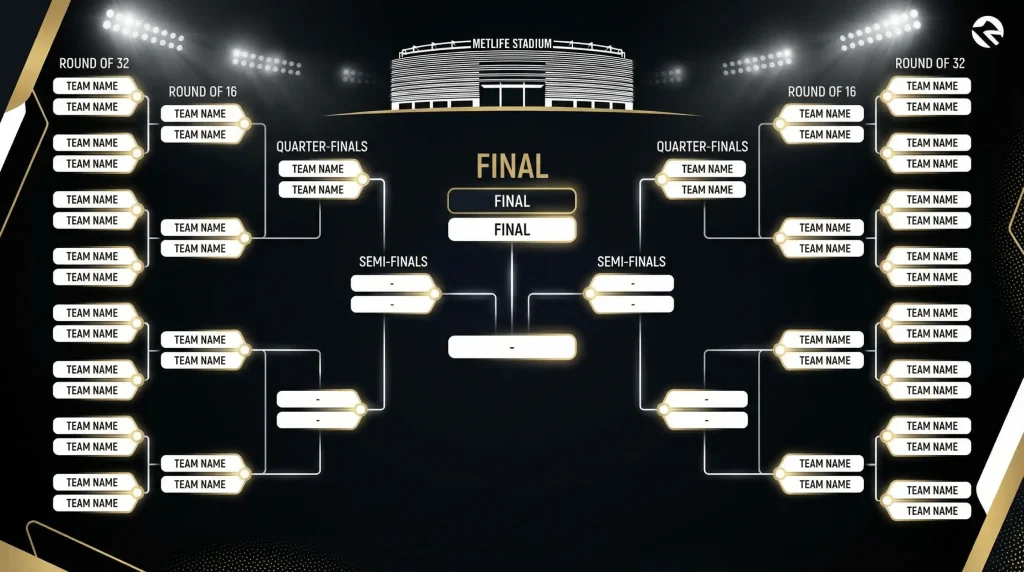
The knockout bracket at a 48-team World Cup is a new beast entirely, and understanding its structure is crucial for outright and deep-run betting. The Round of 32 features 16 matches: each group winner faces a third-placed qualifier, while each group runner-up faces another runner-up from a predetermined bracket. The specific pairings are set by FIFA’s bracket structure, which means a team’s group-stage finish determines not just whether they advance but who they face in the knockout rounds.
For Socceroos fans, the knockout path from Group D depends on finishing position. If Australia finish second in Group D, they enter the half of the bracket that includes Group C’s winner (likely Brazil) and Group L’s winner (likely England) — a brutal draw. If Australia finish as a best third-placed team, they face a group winner in the Round of 32 but from a potentially more favourable section of the bracket. The paradox is that third place might actually produce a better knockout draw than second place in certain scenarios, though it comes with the risk of not qualifying at all.
This bracket asymmetry is where sharp punters can find edges in futures markets. A team like Japan, if they finish second in Group F, might face a runner-up from a weaker group in the Round of 32 — making their odds to reach the quarter-finals better value than a team that tops a different group but lands in the tougher bracket half. The key is mapping the bracket paths before the tournament starts and identifying which group-stage outcomes produce the most favourable knockout routes.
One structural point that bookmakers often underweight: the additional Round of 32 means that teams playing seven or eight matches to reach the final (instead of the previous maximum of seven) face cumulative fatigue and injury risk. Squad depth becomes a tradeable commodity in knockout futures. Teams like France and England, with the deepest squads in the tournament, gain an incremental advantage the further the bracket progresses. It’s a small edge, but small edges are what separate winning punters from the rest over a 39-day tournament.
For Aussie punters running outright or futures bets, the bracket structure also affects hedging strategy. If the Socceroos finish second in Group D and draw a tough Round of 32 opponent, the “to reach the quarter-finals” market might offer poor value — but a separate bet on their Round of 32 opponent to win the match could provide a natural hedge. Thinking about the bracket not as a single path but as a network of interconnected markets is what separates sharp punters from recreational ones at a tournament of this scale.
World Cup 2026 Groups FAQ
From the Draw to the Final — Every Group Tells a Story
Twelve groups, 48 teams, and a group stage that will produce 48 matches before the knockout rounds even begin. For Aussie punters, the 2026 World Cup groups offer more betting opportunities than any previous edition of the tournament — more group winner markets, more qualification markets, more match-level bets, and a third-place qualification mechanism that creates entirely new strategic considerations. The comprehensive betting guide covers the how; this page has covered the who and the where.
Group D is where our hearts will be from 14 June. But smart punting doesn’t stop at the borders of the Socceroos’ group. The value in this tournament is spread across all 12 groups, and the punters who do the work across the full draw — not just the matches they’ll be watching at 2:00 AM — are the ones who’ll come out ahead when the final is played at MetLife Stadium on 19 July.
