
Argentina at the World Cup 2026: Can the Holders Defend Their Crown?
 Available in US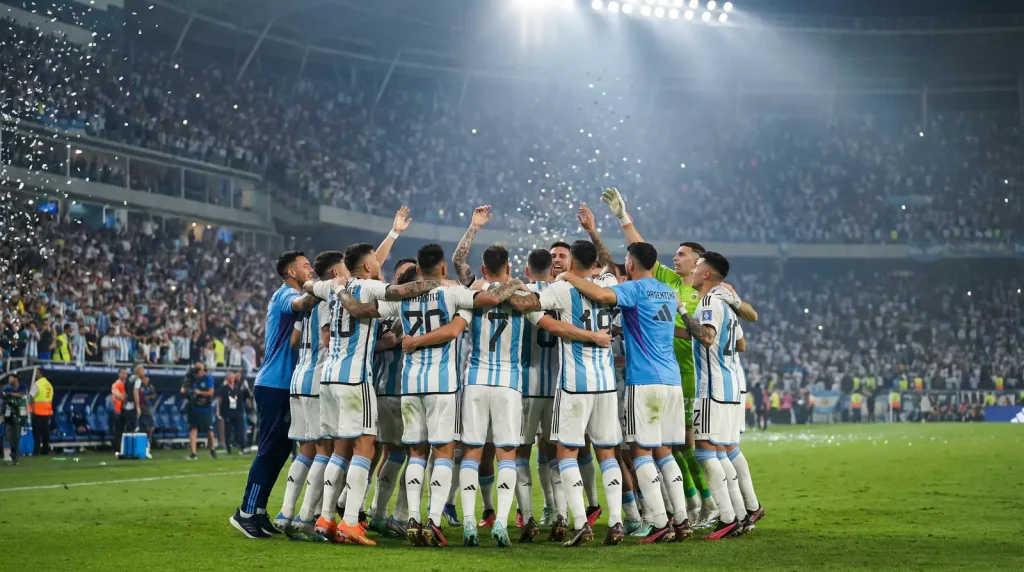
Defending a World Cup title is one of football’s hardest feats. Only two nations have managed it since 1962 — and neither was Argentina. Lionel Scaloni’s side arrive in North America as holders, ranked among the top three in the world, and carrying the weight of a nation that expects nothing less than a repeat. The question for punters is not whether Argentina are good enough. It is whether the odds accurately reflect the difficulty of what they are attempting.
Argentina’s Path to 2026: CONMEBOL Qualifying
South American qualifying is a war of attrition. Eighteen matches across two years, played at altitude in La Paz, in tropical heat in Barranquilla, in the thin air of Quito. No confederation produces a more physically and psychologically demanding qualification pathway, and Argentina navigated it with the authority of a side that knows it belongs at the top.
Argentina finished the CONMEBOL qualifying campaign in the top two, securing automatic qualification without needing to rely on the final matchday. The squad dropped points in away fixtures — everyone does in South American qualifying — but their home record was imperious. Buenos Aires became a fortress, with the Monumental providing an atmosphere that few visiting sides could handle.
What separated Argentina from the rest was consistency in selection. Scaloni rotated sparingly, trusting a core of fifteen players across the campaign. That continuity built understanding on the pitch that tactical boards cannot replicate. The defensive structure, anchored by Cristian Romero and a midfield screen that protects the back four, conceded the fewest goals of any side in the qualification group. Going into the World Cup, that defensive record is one of the reasons bookmakers have Argentina among the shortest-priced sides in the outright market.
The qualifying run also revealed vulnerability. A defeat in Paraguay and a draw in Venezuela showed that Argentina can be disrupted by aggressive pressing and physicality. Teams that match their intensity and refuse to be intimidated find cracks. Colombia’s high press in Barranquilla caused problems through the midfield, and Ecuador’s altitude advantage in Quito forced Scaloni to alter his tactical approach — a rare concession for a coach who rarely deviates from his preferred setup.
That is useful intelligence for punters assessing Argentina’s group matches. Sides with nothing to lose can cause problems, particularly in the opening fixture when tournament nerves affect even the most experienced squads. The CONMEBOL qualifying grind also means Argentina’s key players will have played a significant volume of high-intensity football before the World Cup begins — a factor that could influence performance in the later knockout rounds if the squad is not managed carefully.
Star Players: The Post-Messi Generation?
Every conversation about Argentina at the 2026 World Cup starts with one name, and I am going to address it directly: Lionel Messi will be 39 years old when the tournament begins. Whether he is in the squad, on the bench, or watching from a suite at MetLife Stadium depends on factors that no punter can reliably predict — fitness, form, the decision of a coach who idolises him but must also plan for the future.
The good news for Argentina is that the squad is built to function without Messi as the primary creator. Julian Alvarez, now established as one of the most complete forwards in world football, carries the attacking burden. His movement, finishing and pressing intensity make him the focal point of the attack regardless of who plays behind him. In qualifying, Alvarez scored more goals than any other Argentine player and created chances at a rate that would rank him among the top forwards in any European league.
Enzo Fernandez controls the midfield. His ability to dictate tempo, break up opposition attacks and deliver incisive passes into the final third makes him the engine of this side. At 25, he is entering his prime years and has the experience of a World Cup winner’s medal already in his pocket. Alongside him, Alexis Mac Allister provides the creative spark and goal threat from deeper positions that Messi once monopolised.
The defensive spine is elite. Emiliano Martinez in goal brings the psychological edge that proved decisive in penalty shootouts in Qatar. Romero’s aggressive defending and Lisandro Martinez’s versatility give Scaloni options in a back four that can play high or sit deep depending on the opponent. The fullback positions offer attacking width through Nahuel Molina and emerging options from the Argentine league system.
On the flanks, the depth is remarkable. Lautaro Martinez can rotate with Alvarez or play alongside him. Nicolas Gonzalez, Alejandro Garnacho and a generation of forwards developed in European academies mean Argentina can change their attacking profile without losing quality. This is not a one-man team. It has not been for two years.
Group J: Algeria, Austria, Jordan — Argentina’s Campaign
If you designed a group for the defending champions to navigate comfortably, Group J would be close to ideal. Argentina face Algeria, Austria and Jordan — three sides ranked outside the top 20 and none with recent World Cup knockout experience.
Algeria offer pace on the counter and a passionate support base that travels well, but their squad lacks the quality to sustain pressure against Argentina’s midfield for 90 minutes. Riyad Mahrez’s generation is aging, and while younger players have emerged through the French academy system, the gap in individual quality between Algeria’s best and Argentina’s squad depth is significant. The head-to-head market will price Argentina as overwhelming favourites, and the interest lies in whether Algeria can keep the scoreline respectable or whether the match turns into a showcase for Argentina’s attacking depth.
Austria, under Ralf Rangnick, play an intense pressing game that can trouble possession-based sides. Their performance at Euro 2024 — where they topped a group containing France — demonstrated that Rangnick’s system can produce results against elite opposition. But consistency is the issue. Austria do not have the individual talent to exploit turnovers reliably against defenders of Romero’s calibre, and their pressing intensity tends to drop after 60 minutes. If Argentina can weather the early storm, the match opens up in their favour.
Jordan are making their World Cup debut — a remarkable achievement for a nation with a population under 11 million and a domestic league that generates minimal revenue. Their run to the Asian Cup final in 2024 put them on the global map, but the step up from Asian qualifying to facing the world champions is enormous. For punters, the Jordan match is an opportunity to explore over/under and correct score markets where Argentina’s expected dominance creates high-probability outcomes at reasonable odds.
I expect Argentina to win this group with nine points or close to it. The outright Group J winner market prices them around 1.25, which offers almost no value. The interest for punters lies in the margins — correct score bets, over/under lines, and player markets where Argentina’s attacking depth means goals can come from anywhere.
The group stage schedule places Argentina’s matches across venues in the eastern United States, where the Argentine diaspora is significant. Expect Buenos Aires-level noise inside the stadiums. Home advantage is not exclusive to the host nation — and Argentina’s travelling support has a reputation for creating an atmosphere that lifts their players and unnerves opponents.
Argentina’s Outright Odds and Tournament Markets
At the time of writing, Argentina are priced between 5.00 and 6.50 to win the World Cup across major Australian bookmakers. That places them alongside France and slightly ahead of England and Brazil in most markets. The implied probability at 6.00 is roughly 17% — meaning the market gives Argentina about a one-in-six chance of lifting the trophy.
Is that fair? History says defending champions rarely win consecutive tournaments. Brazil managed it in 1958 and 1962. Italy won in 1934 and 1938 under very different circumstances. France, Germany, Spain — all fell short in their defence. The statistical evidence alone suggests the market might be pricing Argentina’s pedigree slightly too generously relative to the historical difficulty of defending.
But this Argentina side is different from most defending champions. Scaloni’s squad is younger than the one that won in Qatar, with key players now at their peak rather than past it. The tactical system is proven in high-pressure knockout scenarios. And the mental resilience — forged through penalty shootouts, Copa America victories, and the experience of winning when it matters most — is arguably the strongest in the tournament.
For Aussie punters, the question is whether the odds offer value at this price. I lean toward Argentina being slightly overvalued in the outright market — not because they are not good enough, but because the expanded 48-team format introduces more variability. Seven knockout matches to reach the final is one more than any previous champion had to navigate. Each additional round increases the probability of an upset, and at 6.00 the market does not fully account for that structural change. A single penalty shootout going the wrong way — which is essentially a coin flip — can eliminate even the best side in the draw.
The each-way market is worth a look. At those outright odds, an each-way bet that pays for a top-two or top-four finish provides a cushion. Argentina reaching the semi-finals is a high-probability outcome at any price above 2.00 — and some bookmakers offer top-four finishes at around 2.50-3.00. That is where the risk-reward calculus shifts in the punter’s favour. You are betting on Argentina being elite, which they are, without needing them to win four consecutive knockout matches after the quarter-finals.
One market that often gets overlooked is the continent of the winner. South America is priced around 3.00-3.50, reflecting Argentina and Brazil as the primary contenders. If you believe at least one South American side will reach the final and convert, that market offers better odds than backing either nation individually. It is a broader bet that captures upside from both squads without concentrating risk on a single team’s path through the bracket.
Tactical Identity Under Scaloni
Scaloni does not coach a system. He coaches reactions. Argentina’s tactical identity is built on reading the game and adjusting — pressing high when the opponent is vulnerable, dropping into a compact block when the situation demands it, and transitioning between the two phases faster than almost any side in world football.
The base formation is a 4-3-3 that shifts to a 4-4-2 without possession. The midfield triangle — Fernandez at the base, Mac Allister and a rotating third midfielder — provides numerical superiority in the centre of the pitch. This is where Argentina win matches. They control the middle, draw opponents out of position, and then exploit the space created on the flanks or through the channels.
Defensively, the back four is narrow and well-drilled. Romero steps out aggressively to intercept through balls, while Martinez covers behind. The fullbacks tuck in when defending set pieces and push wide when building attacks. It is a system that requires concentration for 90 minutes, and Argentina’s discipline in maintaining their shape under pressure was one of the defining features of their Qatar campaign. In 2022, they conceded just eight goals in seven matches — and three of those came in the chaotic final against France, a match that went to penalties despite Argentina leading 2-0 and then 3-2.
The concern for opponents is that Argentina can hurt you in multiple ways. Against deep-lying defences, they circulate the ball patiently and wait for a moment of disorganisation. Against high-pressing sides, they play through the press with one-touch combinations that bypass the midfield entirely. That adaptability makes them difficult to prepare for and even harder to contain across 90 minutes.
Argentina at the World Cup: A Legacy of Glory
Three stars on the shirt. Fourteen World Cup campaigns. Three titles — 1978 on home soil with a squad driven by Kempes and Passarella, 1986 through the singular genius of Diego Maradona, and 2022 through a collective effort led by Messi in what many assumed would be his final tournament. Argentina’s World Cup history is a story of extremes: moments of transcendent brilliance separated by decades of underachievement and near-misses that scarred a football-obsessed nation.
The 2014 final loss to Germany in extra time, the 2018 group stage collapse in Russia where a 3-0 defeat to Croatia exposed deep tactical flaws, the decades between 1986 and 2022 when the trophy seemed permanently out of reach — these experiences shaped the culture of Argentine football. The pressure to win is immense, generational, and inescapable. It has broken squads in the past — talented sides that folded under the weight of 45 million people demanding perfection.
What makes this current generation different is that they have already tasted victory. They know what it takes to win a penalty shootout with the World Cup on the line. They have stood in the chaos of a Buenos Aires homecoming with three million people in the streets. The burden of expectation is lighter when you have already delivered. Scaloni’s players do not carry the desperation of their predecessors. They carry confidence — and that is a very different energy to bring into a tournament.
For Australian punters, Argentina at the World Cup is always a compelling market. They attract significant betting volume, which keeps the odds sharp and reduces the margin bookmakers can build in. The liquidity in Argentina markets — outrights, group bets, match-by-match — is among the highest of any nation, making it easier to find competitive prices across Sportsbet, Bet365, Ladbrokes and TAB.
The Aussie Punter’s Perspective: Is Argentina Worth the Short Odds?
I get asked this every World Cup cycle — should I back the favourites early or wait? With Argentina, the answer depends on your tolerance for low-return bets. At 5.50-6.50, backing Argentina to win the tournament ties up your bankroll for six weeks and returns a modest profit relative to the risk. Every knockout round introduces the possibility of penalties, red cards, injuries and refereeing decisions that no form analysis can predict. Seven knockout matches from the Round of 32 to the final is a long road, and even the best side in the tournament has perhaps a 20% chance of navigating it cleanly.
Where I see better value for Aussie punters is in Argentina’s group and early knockout markets. Group J winner at 1.25 is dead money — skip it. But Argentina to win the group with a perfect record, or the team total goals over line in the group stage, or Julian Alvarez as the team’s top scorer — these markets offer better prices because they require more specific outcomes. The specificity is your friend. Bookmakers price broad markets tightly because the volume of bets keeps them honest. Niche markets have wider margins, and that is where knowledge of how Argentina play translates into an edge.
The Golden Boot market is another angle. Alvarez is priced around 11.00-15.00 to finish as the tournament’s top scorer. Given that Argentina are likely to face weaker opposition in the group stage and potentially accumulate a high goal tally before the knockout rounds, that price is interesting. He will play every minute of every match, and Scaloni builds the attack around his movement. Compare that to other contenders who may be rested during dead-rubber group matches — minutes on the pitch correlate directly with scoring opportunities, and Alvarez will have more of them than most.
One note on timing. Argentina’s odds will shorten if they cruise through the group stage, but they could drift significantly if they draw an early match or lose a key player to injury. Waiting for the tournament to start before placing your outright bet gives you more information — but at the cost of potentially worse odds if Argentina perform as expected. My approach is to split: place a small outright bet now to lock in the price, and hold a larger portion of your Argentina allocation for in-tournament markets where the value is clearer.
For punters who follow A-League and AFC football closely, there is a useful comparison. Argentina’s tactical approach under Scaloni shares characteristics with the best Asian qualifying sides — defensive discipline, quick transitions, and a willingness to absorb pressure before striking. If you have watched Japan or South Korea dismantle opponents in qualifying through precisely these methods, you understand what Argentina do at a higher level of execution. That familiarity with the style should inform your reading of how Argentina matches will unfold.
Argentina carry two stars earned in 1978 and 1986, a third from Qatar, and the ambition to do what almost no nation has managed — defend a World Cup title. For Aussie punters weighing the World Cup 2026 odds, Argentina’s quality is undeniable, but the price reflects what the market already knows. The edge, if it exists, lies in the specific markets where Argentina’s strength translates into predictable outcomes — not in the outright, where seven knockout matches and 39 days of football stand between them and history.
