World Cup 2026 Odds: Outright Markets, Group Betting and Value Picks for Aussie Punters
 Available in US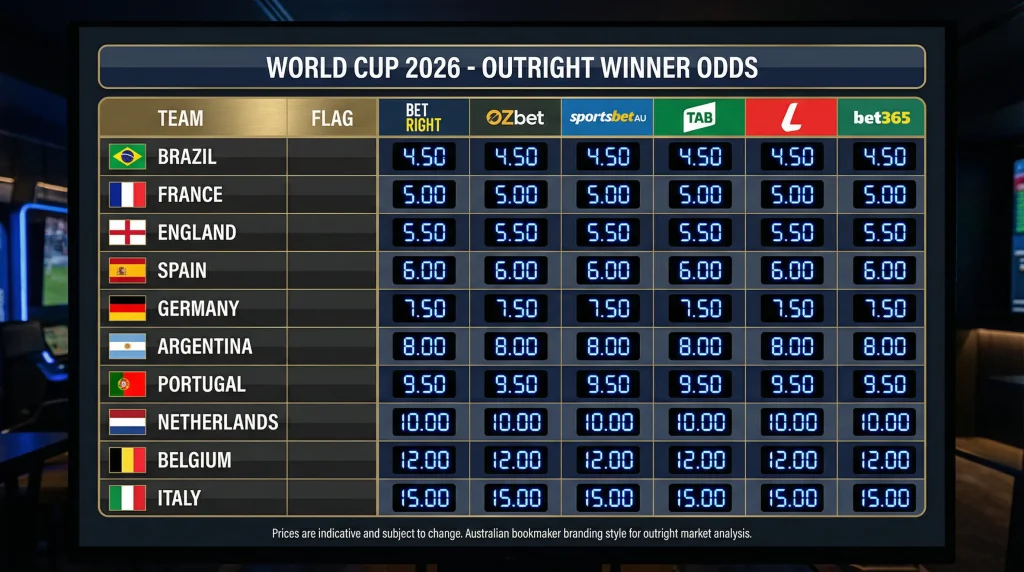
The outright winner market for the 2026 FIFA World Cup opened at most Australian bookmakers within hours of the final group draw, and the early money told a familiar story: Argentina and France at the top, England and Brazil close behind, then a gap before the rest of the field. What the early money doesn’t tell you is where the genuine value sits — because at a 48-team World Cup with a format nobody has seen before, the bookmakers’ models are working with less historical data than at any tournament since the expansion to 32 teams in 1998.
I’ve been tracking World Cup 2026 odds across four licensed Australian platforms since the markets opened, and the movement has been instructive. Some prices have shortened as squad announcements and friendly results confirm pre-tournament assessments. Others have drifted longer as injury news and qualifying form raise questions the market initially overlooked. This page captures the full state of the World Cup 2026 odds landscape — outright winners, Socceroos-specific markets, group winner prices, Golden Boot contenders, and the value bets that I believe the broader market has mispriced.
Reading the Market: How World Cup Odds Are Built
Before diving into specific prices, a quick framework for how bookmakers construct World Cup odds. The outright market is built on probability models that incorporate FIFA rankings, Elo ratings, squad valuations, historical tournament performance, and — crucially for 2026 — the home advantage multiplier for the USA, Mexico, and Canada. Each bookmaker applies their own margin (overround) on top of the raw probabilities, which is why you’ll see different prices for the same team across different platforms. The total overround on a 48-team outright market typically runs between 115% and 130%, meaning the bookmaker’s built-in edge is 15-30%. Shopping for the best available odds across platforms is the single easiest way to reduce that edge.
Odds for the 2026 World Cup are expressed in decimal format — the Australian standard. A price of 6.00 means a $10 bet returns $60 (including your stake) and implies a 16.7% probability. A price of 50.00 means a $10 bet returns $500 and implies a 2% probability. Every odds figure in this article uses the decimal format unless stated otherwise.
Outright Winner Odds: The Full Market
Walk into any TAB, open any licensed betting app in Australia, and the World Cup outright winner market will be front and centre. It’s the simplest bet in the tournament — pick the team that lifts the trophy on 19 July at MetLife Stadium — and it’s also the market where the most money changes hands. The challenge, as always, is distinguishing between the teams that deserve their short odds and the ones where public sentiment has compressed the price beyond fair value.
Argentina, France, Brazil, England — The Frontrunners
Argentina sit at the top of most books between 5.00 and 6.50. As defending champions with a squad that won both the 2022 World Cup and the 2024 Copa América, their credentials are beyond question. The Messi factor adds volatility to this price — if he’s confirmed in the squad (even as a limited-minutes option), expect the odds to shorten by 0.50 to 1.00 as sentimental money floods in. If he’s definitively ruled out, the price could drift to 7.00 or longer. My assessment: Argentina at 6.00 or shorter are not value. Their implied probability at 6.00 is 16.7%, and while they’re the best team in the tournament, the gap between “best team” and “16.7% chance of winning seven or eight consecutive knockout matches across 39 days” is real. I’d want 7.00 or longer to consider an outright bet on Argentina.
France are priced almost identically to Argentina, typically between 5.50 and 7.00. Two World Cup finals in a row (winning in 2018, losing the 2022 final on penalties after Mbappé’s hat-trick) establishes them as the most consistent tournament team of the modern era. Kylian Mbappé at 27 is at the peak of his powers, and the squad depth — Tchouaméni, Camavinga, Saliba, Dembélé — means France can absorb injuries that would cripple other contenders. Didier Deschamps’ pragmatic approach wins tournaments even when it doesn’t win hearts. France at 6.50 or longer represent marginally better value than Argentina at the same price, primarily because France’s squad depth gives them a structural advantage in a tournament that’s one match longer than previous editions.
England’s odds have shortened steadily since their run to the Euro 2024 final. Currently priced between 7.00 and 9.00, England carry the Premier League’s collective talent into a tournament where that depth should matter. Harry Kane, Bukayo Saka, Declan Rice, Jude Bellingham, and Phil Foden form a core that would walk into most national teams. England’s historical inability to convert talent into trophies is the discount factor built into their odds — and at some point, that discount becomes value. I believe England at 8.00 or longer are worth serious consideration for outright bets, particularly each-way if your bookmaker offers quarter-odds on the top two.
Brazil at 7.00 to 9.00 are the most divisive team in the top tier. The talent is obvious — Vinícius Júnior alone can decide matches — but Brazil’s World Cup record since 2002 has been a series of disappointments that suggest a systemic issue rather than individual failures. The 7-1 against Germany in 2014, the listless exit in 2018, the penalty shootout loss to Croatia in 2022 — each tournament brought new players but the same outcome. I’d want Brazil at 9.00 or longer to feel comfortable with an outright bet, and even then, I’d prefer tournament-stage markets (Brazil to reach the semi-finals at 2.50-3.00) over the outright.
Spain, Germany, Portugal, Netherlands — Strong Contenders
The second tier of the outright market is where sharp punters often find the most actionable odds. These teams are good enough to win the World Cup but priced long enough that the expected value calculation works in the punter’s favour if the assessment is right.
Spain at 8.00-11.00 stand out as potentially the best value in the entire outright market. The reigning European champions, winners of Euro 2024 with a squad built around Lamine Yamal (who will be 18 during the tournament), Pedri, Gavi, and Rodri — Spain combine youth, tactical sophistication, and a winning mentality forged at the 2024 Euros. Their Group H draw includes Uruguay, which is a genuine test, but the knockout path from that group could be favourable depending on seedings. If you’re placing one outright bet on the 2026 World Cup, Spain at 10.00 or longer is where I’d put my money. The implied probability at 10.00 is 10%, and I’d assess their actual chances at closer to 12-14%.
Germany at 12.00-15.00 are a team I approach with caution. Two consecutive group-stage exits (2018 and 2022) would normally disqualify a team from serious contention talk, but Germany’s home Euros in 2024 showed signs of revival. The question is whether that momentum carries across two years into a tournament on the other side of the Atlantic. At 15.00, there might be value; at 12.00, I’d pass.
Portugal sit between 10.00 and 14.00, and their market position reflects both the talent (Bernardo Silva, Bruno Fernandes, Rafael Leão) and the questions (can they function as a unit rather than a collection of individuals?). Cristiano Ronaldo’s status — whether he’s selected, what role he plays — will move the odds in both directions depending on your view. Group K with Colombia is a genuine obstacle, and Portugal’s knockout pedigree (quarter-final exits in 2022 and Euro 2024) suggests a team that peaks too early or cracks under pressure.
The Netherlands at 15.00-20.00 are interesting. Ronald Koeman’s side are structured, efficient, and possess Virgil van Dijk and a midfield that controls possession effectively. Their Group F draw (Japan, Sweden, Tunisia) is tricky, but a team that navigates it will arrive in the knockout rounds battle-hardened. At 18.00 or longer, the Netherlands offer the kind of each-way value that makes outright markets worth engaging with.
Socceroos Odds: How Far Can Australia Go?
Let’s address the elephant in the room: the Socceroos are not going to win the 2026 World Cup. Their outright odds — typically between 100.00 and 200.00 — reflect a probability of 0.5-1.0%, and no amount of patriotic optimism changes that calculus. But outright winner odds are only one small slice of the Socceroos betting market, and it’s in the group-stage and qualification markets where genuine punting value exists.
Group D Winner and Qualification Odds
The Socceroos’ odds to win Group D — finishing above the USA, Turkey, and Paraguay — sit between 4.00 and 5.50 across licensed Australian platforms. That implies a 18-25% probability, which feels about right. Topping the group would require beating or drawing with the USA on their home turf, and while it’s not impossible, it’s the least likely path to the knockout rounds for Australia.
The more interesting market is “Socceroos to qualify from the group” (finish top two or as a best third-placed team). This is typically priced between 1.70 and 2.00, implying a 50-59% probability. My own assessment puts Australia’s qualification probability at approximately 60-65%, based on three factors the market may be underweighting. First, the third-place safety net — even if Australia finish third in Group D, a record of one win and one draw (four points) from three matches would almost certainly be enough for a best third-place spot. Second, the west coast scheduling advantage — all three matches in the Pacific Time zone means minimal travel disruption and the most AEST-friendly viewing for fans, which translates into a genuine support factor at BC Place in Vancouver, the venue for the crucial Turkey opener. Third, Turkey’s qualification through the UEFA playoffs means they had less preparation time and carry the fatigue of additional competitive fixtures, which could blunt their sharpness in the opening match.
At 1.90 or longer, Socceroos to qualify from Group D is the best value bet in the Australian market for this tournament. It’s not a certainty — nothing at a World Cup is — but the risk-reward profile is favourable.
Round of 32 and Beyond — Socceroos Futures
If the Socceroos advance from the group stage, the Round of 32 becomes the next betting checkpoint. As a second-place or third-place finisher from Group D, Australia would face either a group winner from a predetermined bracket slot or another runner-up. The specific opponent depends on final group standings across the tournament, but the possible matchups range from manageable (a group winner from a weaker group like Group G or Group J) to daunting (a powerhouse like Brazil or England from the tougher bracket half).
Socceroos to reach the quarter-finals is typically priced between 5.00 and 8.00, which implies they’d need to win one knockout match after qualifying from the group. Given the Round of 32’s seeded structure (where group winners are favoured against third-placed qualifiers), this bet depends heavily on which side of the bracket Australia lands in. I see it as a speculative bet rather than a value play — worth a small stake for the emotional ride, but not a serious bankroll commitment.
For punters who want maximum Socceroos engagement without the long odds of outright or deep-run bets, match-level markets are the way to go. Australia to beat Turkey at around 2.50-2.80, under 2.5 goals in the Paraguay match at 1.65-1.80, and Australia double chance (win or draw) against the USA at 2.80-3.20 — these are the bets that let you back the green and gold with a rational assessment of probability rather than blind hope.
Group Winner Odds Across All 12 Groups
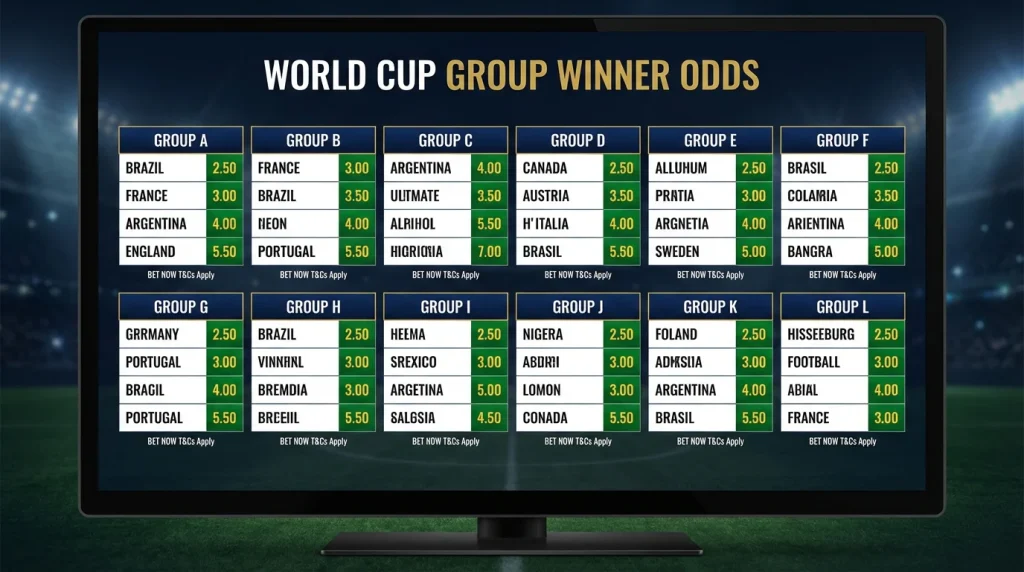
Group winner markets are among my favourite World Cup bets because they offer a contained, analysable outcome. You’re not trying to predict seven matches — you’re predicting three. The team that finishes top of their group after the round-robin has won the market, and the odds available before the tournament starts often contain genuine mispricing because bookmakers model group outcomes based on pre-tournament data that doesn’t account for matchday-specific factors like tactical setups, travel fatigue, and altitude (relevant for Mexico City matches at the Azteca, which sits at 2,200 metres above sea level).
The shortest group winner prices in the tournament belong to Argentina in Group J (1.30-1.45) and Brazil in Group C (1.45-1.60). These are fair but offer thin margins — you’re laying heavy odds for modest returns. The longest group winner prices among the expected favourites sit in Groups F and L: the Netherlands at 1.80-2.10 in Group F (where Japan present a genuine challenge) and England at 1.60-1.80 in Group L (where Croatia have proven World Cup knockout pedigree).
The value, though, isn’t always with the favourites. In Group A, South Korea at 2.80-3.50 to top a group featuring Mexico, South Africa, and Czechia is a price that reflects the market’s default deference to the host nation (Mexico) without fully accounting for Son Heung-min’s tournament-elevating quality. In Group H, Uruguay at 3.50-5.00 to win a group containing Spain, Cabo Verde, and Saudi Arabia looks long for a two-time World Cup champion with a squad that includes some of the most talented attacking players in world football. And in Group K, Colombia at 3.00-4.00 to top a group with Portugal, DR Congo, and Uzbekistan could represent overlay if Portugal’s recent tournament underperformance (quarter-final exits at Euro 2024 and the 2022 World Cup) continues.
My approach to group winner betting is to identify two or three groups where I believe the market has the wrong favourite or has underpriced the second-strongest team, and to place modest stakes early — before squad announcements and pre-tournament friendlies move the lines. Groups where the top two teams are closely matched (F, K, L) tend to produce the most value because the odds on either potential winner are longer than they’d be in a group with a clear frontrunner.
Golden Boot Odds: Top Scorer Market
The Golden Boot — awarded to the tournament’s top scorer — is one of the most popular futures markets at any World Cup, and the 2026 edition brings a twist: more matches mean more goals. With the Round of 32 adding an extra knockout round, a team reaching the final could play eight matches instead of the previous maximum of seven. That additional game inflates scoring potential for strikers from elite nations, which is why the market’s top choices are almost exclusively players from teams expected to go deep.
Kylian Mbappé leads most Australian bookmakers’ Golden Boot markets at around 8.00-10.00. His pace, positioning, and penalty-taking duties for France make him the obvious choice, and his hat-trick in the 2022 World Cup final demonstrated his ability to deliver on the biggest stage. Harry Kane typically sits at 9.00-12.00, backed by his club scoring record and England’s expected deep run. Vinícius Júnior, who has evolved from a devastating winger into a complete forward at Real Madrid, is usually priced between 12.00 and 16.00.
The value in Golden Boot markets rarely sits with the outright favourite. At past World Cups, the top scorer has often been a player who benefited from group-stage blowouts against weaker opposition rather than consistent scoring across the knockout rounds. With 48 teams in 2026, the group stage will produce more mismatches than usual — a striker from a top team drawn in a group with a debutant or minnow could score three or four goals in group matches alone, giving them a head start in the race. This dynamic favours players from teams in softer groups: Germany’s striker in Group E (facing Curaçao), Argentina’s forward line in Group J (facing Jordan), or Spain’s attackers in Group H (facing Cabo Verde).
Erling Haaland at 15.00-20.00 is an intriguing outlier. Norway are unlikely to advance past the group stage (Group I with Argentina, Senegal, Iraq), which limits Haaland to three matches. But his club scoring rate is so extraordinary — and his ability to score multiple goals in a single game so well-documented — that three matches might be enough if Norway face Iraq and Senegal in fixtures where they’re expected to create chances. It’s a high-risk, high-reward proposition that perfectly encapsulates what Golden Boot betting should be: not a prediction of the most likely outcome, but an assessment of where the odds offer value relative to the probability.
One angle Australian punters should consider: the each-way market for Golden Boot. Several licensed bookmakers offer each-way terms (typically quarter-odds for a top-three finish) on the top scorer market. An each-way bet on a player priced at 20.00 returns at 5.00 (quarter-odds) if they finish in the top three scorers — and at a World Cup where the top three or four scorers often finish within a goal of each other, the each-way place part of the bet can hit even when the win part doesn’t. Mbappé or Kane each-way at their current prices is a smarter play than backing them to win outright, because the margin between first and third in the Golden Boot race is almost always one or two goals.
Value Bets and Longshots Worth Watching
Every World Cup produces at least one result that makes outright longshot punters look like geniuses. Greece at Euro 2004, Leicester in the Premier League, Croatia reaching the 2018 final from odds of 30.00 or longer — sport’s capacity to defy probability is the reason we punt in the first place. The trick is distinguishing between longshots that have a genuine mathematical edge and longshots that are priced long for very good reasons.
Morocco at 30.00-45.00 to win the World Cup outright are my top value pick in the longshot category. Their 2022 semi-final run was not a fluke — it was built on elite defensive organisation, a coach who understands tournament football, and a squad where virtually every player competes at the highest level of European club football. They face Brazil in Group C, which is a stern test, but Morocco have shown they can match and beat teams of that calibre. If they navigate the group and draw favourably in the knockout bracket, a second consecutive deep run is entirely plausible. The outright odds imply a 2-3% chance; I’d put their probability of winning the tournament at 4-5%, which makes this a clear value bet.
Colombia at 35.00-50.00 are another value play. Their Copa América 2024 semi-final run demonstrated a squad that’s balanced across all positions, and Group K (Portugal, DR Congo, Uzbekistan) — while challenging — is navigable. Colombia’s rhythm at major tournaments tends to build through the group stage, and a second-place finish behind Portugal could produce a favourable knockout draw. The same logic applies to Japan at 40.00-60.00, though Japan’s Group F (Netherlands, Sweden, Tunisia) is arguably tougher than Colombia’s draw.
At the extreme longshot end, two teams are worth a micro-stake punt purely on the mathematics. The USA at 12.00-15.00 aren’t a longshot by any definition, but the home advantage factor — which historically adds 1.5 to 2 goals per tournament to the host nation’s expected performance — is arguably underpriced in their outright odds. A young, athletic squad playing every knockout match on home soil in front of capacity crowds is a different proposition to the USA teams that underperformed at overseas World Cups. South Korea at 60.00-80.00, in a group (A) they could realistically win, with a potential knockout path that avoids the tournament’s heavyweights until the quarter-finals, are the kind of informed longshot that makes watching the group stage with a small bet in your pocket genuinely thrilling.
The broader lesson with value betting at a World Cup is this: the public hammers the favourites, which means the bookmaker’s margin is extracted disproportionately from the longshot end of the market. Teams priced between 25.00 and 60.00 are where the margin compression is least severe and where your own analysis — especially if you follow AFC football closely, as many Australian punters do — can genuinely outperform the market’s assessment. A disciplined approach to value betting means placing several small outright stakes across the 25.00-60.00 range rather than one large bet on a favourite. If any one of those longshots comes through, the return more than covers the combined outlay on all of them. That’s the portfolio approach to World Cup punting, and over multiple tournaments, it’s the strategy that produces the best long-term results.
Decimal Odds Refresher: A Quick Primer
If you’ve read this far, you probably know how decimal odds work. But I’ve learned from experience that even seasoned punters sometimes confuse implied probability with actual probability, and that confusion costs money. The full betting guide covers this in depth, so here’s the short version.
Decimal odds represent total return per dollar staked, including your original stake. Odds of 4.00 mean a $10 bet returns $40 — that’s $30 profit plus your $10 back. To convert decimal odds to implied probability, divide 1 by the odds and multiply by 100: 1/4.00 x 100 = 25%. Crucially, implied probability includes the bookmaker’s margin — the actual probability the bookmaker assigns to the outcome is lower than the implied probability you calculate from the odds. This means every price you see is slightly worse than fair value, and the punter’s job is to find selections where the gap between their own assessment and the bookmaker’s implied probability is large enough to overcome that built-in margin.
At a World Cup with 48 teams, the margin is spread across more selections, which paradoxically can create more value opportunities. When a bookmaker has to price all 48 teams in an outright market, the odds for teams ranked 20th through 48th receive less analytical attention than the top contenders. This is where sharp punters find edges — not in the Argentina-versus-France battle at the top of the market, but in the relative pricing of teams like Morocco versus Colombia versus Japan in the 30.00-60.00 range.
World Cup 2026 Odds FAQ
The Odds Are Set — Now It’s Time to Find Your Edge
The World Cup 2026 odds market is the deepest and most complex betting landscape in international football. Forty-eight teams, 12 group winner markets, a Golden Boot race stretched across 104 matches, and an outright winner field where the gap between the favourites and the dark horses is narrower than at any previous edition. For Aussie punters, the combination of decimal odds, licensed bookmakers with competitive pricing, and the emotional engagement of the Socceroos’ Group D campaign makes this tournament a punting event like no other.
The numbers tell their story, but numbers alone don’t win bets. What wins bets is the gap between what you know and what the market knows — and at a World Cup with four debutants, a new format, and a tournament stretched across three countries and five time zones, those gaps are wider than usual. Do the work, trust your analysis, and remember that the best bet is always the one where the odds are in your favour, not the one where you want the outcome most.
The Socceroos kick off against Turkey on 14 June. The odds are live. The tournament is coming.