
MetLife Stadium: World Cup 2026 Final Venue — The Stage for Football’s Biggest Night
 Available in US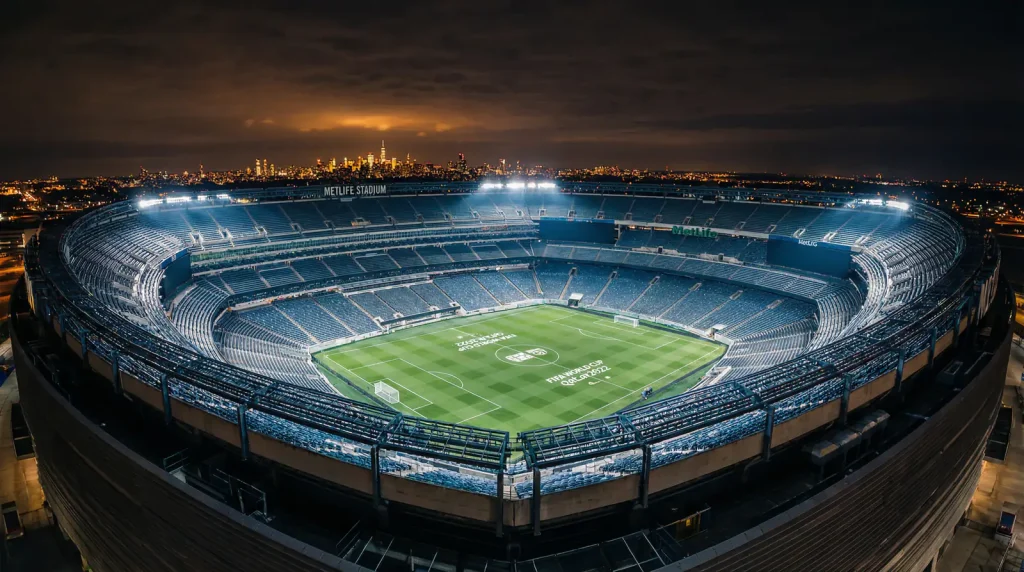
Every four years, one stadium gets to host the most-watched sporting event on Earth. On 19 July 2026, that honour falls to MetLife Stadium in East Rutherford, New Jersey — and for Australian punters, the World Cup Final kicks off at approximately 8:00 AM AEST on a Sunday morning. Not a bad way to spend your weekend, I’d say. Whether it’s the Socceroos lifting the trophy (stranger things have happened) or a European heavyweight claiming another star, this 82,500-seat colossus fifteen kilometres west of Manhattan will be where footballing history is written.
MetLife Stadium represents everything this tri-nation World Cup is about: American scale meeting global ambition. Opened in 2010 at a construction cost of US$1.6 billion, it remains one of the most expensive stadiums ever built. The venue already knows how to handle massive events — Super Bowls, WrestleMania, international friendlies that drew 80,000 fans. But a World Cup Final? That’s different. That’s 1.5 billion television viewers worldwide. That’s the culmination of 104 matches across 39 days. That’s everything.
MetLife Stadium: Where American Ambition Meets Global Football
I remember when they announced the venue selections back in 2022, and MetLife was always the frontrunner for the Final. The stadium ticks every FIFA box: massive capacity, modern infrastructure, proximity to a major international airport, and perhaps most importantly, the New York media market. This is the biggest stage American sport can offer, and FIFA wants that spotlight.
The numbers tell the story. MetLife Stadium’s official capacity sits at 82,500, though FIFA configurations might adjust that slightly for optimal sightlines and broadcast requirements. The venue features 218 luxury suites, four primary clubs, and over 10,000 premium seats — the kind of corporate hospitality infrastructure that makes FIFA’s commercial partners very happy. The playing surface will be temporary natural grass laid over the stadium’s usual artificial turf, matching the standard across all US venues for this tournament.
What sets MetLife apart from other American mega-stadiums is its open-air design. Unlike the retractable roof venues in Arlington or Inglewood, MetLife embraces the elements. July in New Jersey typically delivers warm, humid conditions with temperatures averaging 29°C — not ideal for high-intensity football, which explains why the Final kicks off in the evening local time (8:00 PM ET, translating to that 8:00 AM AEST Sunday start). The stadium’s orientation minimises direct sun interference on the pitch during evening matches, a detail FIFA’s technical team specifically evaluated.
Getting 82,500 people in and out of a stadium located in the Meadowlands of New Jersey sounds like a logistical nightmare, but MetLife has refined this through years of NFL doubleheaders. The venue sits at the intersection of major highways with over 28,000 parking spaces, and NJ Transit operates direct rail service from Penn Station Manhattan to Meadowlands Station on game days. For the World Cup Final, expect expanded transit options and road closures that turn the entire area into a controlled access zone.
World Cup 2026 Matches at MetLife Stadium
The Final alone would justify MetLife’s place in World Cup history, but this stadium hosts far more than just the climactic match. FIFA has allocated some of the tournament’s most significant fixtures to East Rutherford, recognising both the venue’s capacity and its symbolic importance to American soccer.
Here’s the full MetLife Stadium schedule converted to Australian Eastern Standard Time:
| Date | Round | Match | AEST Kick-Off |
|---|---|---|---|
| 15 June (Sun) | Group Stage | Group I: France vs Senegal | 5:00 AM |
| 19 June (Thu) | Group Stage | Group J: Argentina vs Algeria | 9:00 AM |
| 23 June (Mon) | Group Stage | Group I: France vs Iraq | 5:00 AM |
| 27 June (Fri) | Group Stage | Group J: Argentina vs Jordan | 6:00 AM |
| 5 July (Sat) | Round of 16 | Knockout match | 8:00 AM |
| 12 July (Sat) | Quarter-Final | Knockout match | 8:00 AM |
| 15 July (Tue) | Semi-Final | Knockout match | 8:00 AM |
| 19 July (Sat) | Final | World Cup Final | 8:00 AM |
Notice the pattern: France twice, Argentina twice — FIFA stacks the biggest draws at the biggest venue. The group stage matches alone guarantee massive attendances, but it’s the knockout rounds where MetLife truly earns its Final venue status. The Round of 16, Quarter-Final, and Semi-Final allocations mean this stadium could host the same team across multiple knockout stages, building narrative momentum toward the Final itself.
For Australian viewers, every MetLife match falls in the morning AEST window. The 5:00 AM and 6:00 AM starts for group games demand some commitment, but the knockout rounds at 8:00 AM feel almost civilised. Sunday morning, Final day, 8:00 AM — grab your coffee, settle into the couch, and watch history unfold. SBS will broadcast all 104 matches free-to-air, so no subscription barriers between you and the biggest game of the tournament.
New York and New Jersey: The World Cup Epicentre
When people say the World Cup Final is in New York, they’re being geographically generous. MetLife Stadium technically sits in East Rutherford, New Jersey, about fifteen kilometres west of Midtown Manhattan. The distinction matters for travelling fans, but in practical terms, the New York metropolitan area functions as one massive hosting region with Manhattan as its cultural and commercial heart.
The FIFA Fan Festival will likely centre on Manhattan, probably in Central Park or along the Hudson River waterfront, creating a dual-city dynamic where supporters shuttle between Jersey entertainment districts and NYC party zones. This is a market of over 20 million people — the largest metropolitan area in the United States — and the World Cup Final will dominate everything for weeks.
For Australian fans making the pilgrimage, the logistical considerations start with flights. Sydney to New York JFK runs approximately 20 hours with typical stopovers in Los Angeles or San Francisco. Direct flights from Australia don’t exist, so budget at least 24 hours of total travel time. The good news: JFK and Newark airports both serve the metropolitan area, with Newark actually closer to MetLife Stadium. A July 2026 return flight from Sydney to New York will likely run between A$3,000 and A$6,000 depending on booking timing and class.
Accommodation during the Final will be scarce and expensive. Manhattan hotels that normally charge A$300 per night will triple or quadruple rates for Final week. Smart punters look to Newark, Jersey City, or even Philadelphia (90 minutes by train) for more reasonable options. Airbnb regulations in New York City are strict, so don’t assume the sharing economy will provide cheap alternatives.
The time zone difference between New York (Eastern Time, UTC-5) and Australian Eastern Standard Time (UTC+10) spans 15 hours during July. When it’s 8:00 PM in East Rutherford for the Final kick-off, it’s 10:00 AM the next morning in Sydney. Planning your watch parties accordingly — most Australian fans will experience the Final over Sunday breakfast rather than Saturday night.
World Cup Final Betting Markets
The outright winner market for the World Cup 2026 has been open since Qatar 2022 ended, and the odds have shifted considerably as qualification unfolded and form revealed itself. As of early 2026, the World Cup 2026 odds market shows a familiar collection of favourites, though this tournament’s expanded format introduces genuine uncertainty about knockout bracket paths.
Argentina, the defending champions, sit near the top of most bookmaker markets — typically around $5.00 to $6.00. Whether Lionel Messi features remains the question that moves the needle most dramatically; his presence shortens odds significantly, his absence lengthens them. France hover in similar territory, having reached consecutive Finals in 2018 and 2022. The Les Bleus’ depth and tournament pedigree make them perennial Final contenders.
England, the eternal “it’s coming home” narrative, typically price between $7.00 and $9.00. Brazil, desperate to end their 24-year trophy drought, sit in the same range. Germany and Spain offer slightly longer odds, usually $10.00 to $15.00, reflecting both their historical pedigree and recent competitive performances.
For value-seeking punters, the interesting markets involve specific Final matchups. Argentina vs France rematch, for instance, carries specific odds given they delivered one of the greatest Finals in history in Qatar. An all-South American Final (Argentina vs Brazil) or all-European Final (France vs England) attract novelty bets with decent payouts.
The host nation factor deserves consideration. USA enter as automatic qualifiers with home advantage across 78 matches on American soil, including the Final. Historically, host nations outperform their seeding — South Korea’s 2002 run remains the most dramatic example. The USA at $15.00 to $25.00 represents genuine each-way value if you believe home crowd energy, familiar conditions, and zero travel can propel them beyond expectations.
The MetLife Stadium Experience
Attending a World Cup Final differs fundamentally from watching on television, and MetLife Stadium amplifies that difference through sheer scale. The venue’s bowl design, with seating on all four sides and no corners or gaps, creates an enclosed atmosphere that concentrates crowd noise directly onto the pitch. NFL teams have measured crowd decibel levels exceeding 100dB during crucial plays — expect similar intensity when a Final goes to penalties.
The stadium features 54 escalators and over 100 points of entry, designed to move NFL crowds efficiently during American football’s tight scheduling windows. For World Cup matches, these systems will be stress-tested by international crowds less familiar with American stadium procedures. Arriving early isn’t just recommended — it’s essential. FIFA typically opens gates three hours before Final kick-off.
Food and beverage options span typical American stadium fare: hot dogs, burgers, pizza, beer. Prices will be premium — expect A$15 for a domestic beer, A$20 for anything craft. The stadium’s no-bag policy (clutch bags under 4.5″ x 6.5″ only) reflects American security standards that might surprise international visitors. Everything goes through metal detectors and visual inspection.
Seating categories for the Final will stratify dramatically by price. Lower bowl sideline seats behind the team benches command the highest premiums — we’re talking five figures in US dollars for legitimate secondary market tickets. Upper deck corners, while distant, offer the most accessible entry point, likely still running into several thousand dollars. FIFA’s official ticketing lottery remains the only non-secondary path to tickets, and those applications typically close months before the tournament.
The post-match experience matters as much as the match itself. FIFA coordinates the trophy presentation, medal ceremonies, and victory lap that turn a World Cup Final into a three-hour spectacle beyond the 90 minutes of play. The winning nation’s fans stay for hours, singing, celebrating, creating memories. Losing fans face a more sombre departure. Either way, plan for extensive delays exiting the venue and surrounding transport networks.
The Socceroos’ Path to MetLife
Let’s indulge the dream for a moment. Australia, drawn in Group D with USA, Paraguay, and Turkey, would need to navigate a specific knockout bracket path to reach East Rutherford on 19 July. The route depends entirely on group finishing position, but a plausible scenario exists.
If the Socceroos finish second in Group D behind the host nation USA, they’d likely enter the Round of 32 in the bracket half that feeds toward certain Quarter-Final venues. Following that path, avoiding the heaviest hitters in early rounds, a Semi-Final berth becomes conceivable rather than fantastical. From there, one match separates an Australian team from the World Cup Final stage.
Has Australia ever reached a World Cup Final? No. Have they ever reached the Semi-Finals? No — the furthest the Socceroos have progressed is the Round of 16 in 2006. But this 48-team format, with its expanded knockout pathways and opportunities for bracket luck, creates mathematical possibilities that previous tournaments didn’t offer. Eight extra teams qualifying from groups means more routes to the deep rounds.
The outright odds on Australia winning the World Cup typically sit beyond $151.00 — genuine longshot territory. But for patriotic punters willing to throw a small stake at a massive dream, the payoff would be life-changing. And if somehow, impossibly, gloriously, the Socceroos reached MetLife Stadium for the Final, we’d all remember exactly where we were when the impossible became real.
The more realistic betting angle involves backing Australia for specific round achievements: qualifying from Group D (much shorter odds, around $2.50 to $3.00), reaching the Quarter-Finals ($10.00 to $15.00), or making a Semi-Final run ($30.00 to $50.00). Progressive bets like these let you celebrate multiple checkpoints rather than waiting for one all-or-nothing outcome.
MetLife Stadium on 19 July 2026 represents the pinnacle of everything this World Cup offers. Eighty-two thousand fans, 1.5 billion viewers, one match to decide everything. Whether you’re watching from East Rutherford or East Sydney, the moment the referee blows the final whistle and confetti falls on the new world champions will define a generation of football memories. Set your alarms, back your picks, and prepare for the biggest morning in Australian sports viewing — the World Cup Final awaits.
