
Didier Deschamps’ World Cup 2026 *Farewell*: 14 Years, One Last Match
 Available in US
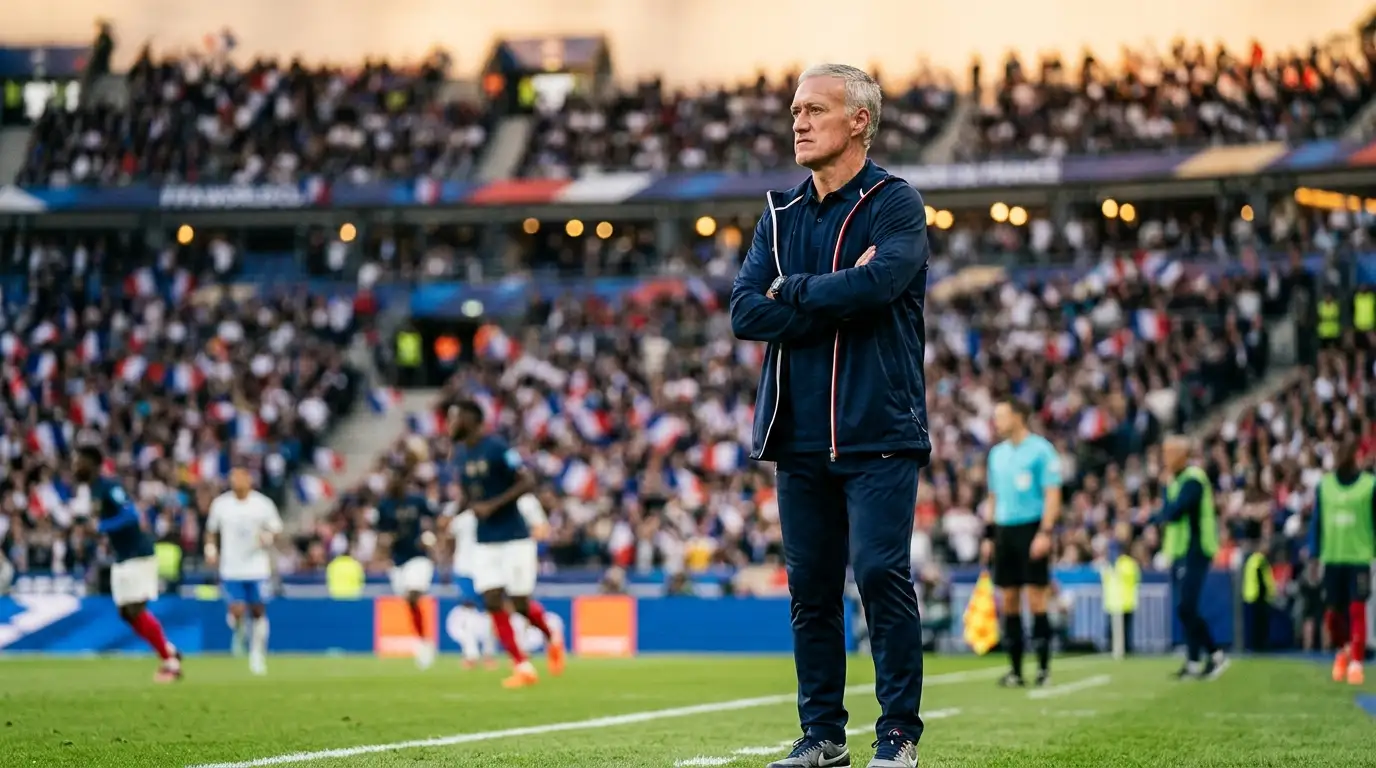
When France take the pitch against England in Saturday’s third-place play-off at Hard Rock Stadium in Miami (07:00 AEST Sunday for Aussie viewers), it will mark the end of an era. Didier Deschamps, France’s coach for 14 years, will manage his final match for Les Bleus before stepping down.
It’s an understated farewell for a man who guided France to World Cup glory in 2018, the 2022 World Cup final, the 2026 semi-finals, and the Euro 2016 final on home soil. Deschamps is one of just three people to win the World Cup as both a player (1998) and a coach (2018), alongside Brazil’s Mário Zagallo and Germany’s Franz Beckenbauer.
But this tournament has been defined as much by personal tragedy as by on-field success. Deschamps lost his mother during the group stage and briefly left the squad before returning to lead France through the knockout rounds.
He has barely spoken about it publicly. When asked about his tenure in Friday’s pre-match press conference, Deschamps offered a brief reflection: "I had the privilege of experiencing moments that were magical, and others that were difficult. But life goes on. I’m a positive person, and I know things will be good, too. It’s the best thing that ever happened to me."
For a coach who has given France 14 years, two World Cup finals, and a World Cup title, Saturday’s bronze match is a poignant, bittersweet send-off. And for Aussie fans watching from home after the Socceroos’ round-of-32 exit, it’s a reminder that football is about more than just tactics and trophies.
The Deschamps Era: 14 Years, Two Finals, One Title
Didier Deschamps was appointed France coach in July 2012, inheriting a side in turmoil following their disastrous 2010 World Cup campaign (a group-stage exit marked by a players’ revolt) and a quarter-final defeat at Euro 2012.
He rebuilt the squad around a core of emerging stars — Paul Pogba, N’Golo Kanté, Antoine Griezmann, Kylian Mbappé — and instilled a pragmatic, defensively solid style that prioritised results over aesthetics. Critics called it boring. Deschamps called it winning.
His record speaks for itself:
- 2014 World Cup (Brazil): Quarter-finals (lost 1-0 to Germany, the eventual champions)
- Euro 2016 (France): Runners-up (lost 1-0 to Portugal in extra time in the final on home soil)
- 2018 World Cup (Russia): Champions (beat Croatia 4-2 in the final)
- Euro 2020 (played in 2021): Round of 16 (knocked out by Switzerland on penalties in a shock upset)
- 2022 World Cup (Qatar): Runners-up (lost to Argentina on penalties in the final after a 3-3 draw)
- 2026 World Cup (USA/Canada/Mexico): Semi-finals (lost 2-0 to Spain)
That’s three major tournament finals (Euro 2016, World Cup 2018, World Cup 2022) and one title. Only Germany’s Joachim Löw (2008-2021) and Spain’s Vicente del Bosque (2008-2016) match Deschamps’ consistency at the top of international football in the modern era.
He joined an exclusive club of just three men to win the World Cup as both a player and a coach:
- Mário Zagallo (Brazil, player in 1958/1962, coach in 1970)
- Franz Beckenbauer (Germany, player in 1974, coach in 1990)
- Didier Deschamps (France, player in 1998, coach in 2018)
When Deschamps steps down after Saturday’s match, he’ll leave as one of the most successful coaches in French football history — and one of the most successful international coaches of the 21st century.
The Mother’s Death: Tragedy During the Tournament
Deschamps’ mother died on 23 June 2026, the day after France’s group-stage win over Iraq clinched their place in the knockout rounds with one group match remaining, against Norway.
Deschamps flew back to Europe immediately to attend her funeral and missed the Norway match. Assistant coach Guy Stéphan took charge in his absence, overseeing a 4-1 win in which Ousmane Dembélé scored a hat-trick.
Deschamps returned to the squad in time for France’s round-of-32 match against Sweden (a 3-0 win), but he has barely addressed his mother’s death publicly. French media have largely respected his privacy, and Deschamps himself has deflected questions about it in press conferences.
When the subject came up in Friday’s pre-match press conference, he kept it brief, reflecting on a tenure that had brought both magical and difficult moments and saying he was staying positive about what lay ahead.
Deschamps knows this stage as well as anyone. As France’s captain, he lifted the World Cup in 1998 and the European Championship in 2000, cementing his legacy as one of the great leaders in French football.
Saturday’s bronze match will be his last in the spotlight. After 14 years of managing France through triumphs and tragedies, Deschamps will step aside. Zinedine Zidane — his former teammate and the "open secret" successor — is widely expected to take over, though no official announcement has been made.
The 2026 Tournament: Tactical Masterclass, Semi-Final Heartbreak
France entered the 2026 World Cup as one of the favourites, and Deschamps delivered a tactically astute campaign. Les Bleus topped Group I with 10 goals scored and just two conceded, then navigated the knockout rounds with clinical efficiency:
- Round of 32: France 3-0 Sweden
- Round of 16: France 1-0 Paraguay
- Quarter-finals: France 2-0 Morocco
- Semi-finals: France 0-2 Spain (out-possessed, held to 0.30 xG)
France’s semi-final defeat to Spain was their first loss of the tournament. Spain dominated possession, suffocated France’s midfield, and held Les Bleus to just 0.30 expected goals (xG) — France’s lowest xG at a World Cup in 60 years.
Deschamps’ pragmatic approach — sitting deep, absorbing pressure, and counter-attacking through Kylian Mbappé and Ousmane Dembélé — had carried France through six matches. But against Spain’s possession-based dominance, France couldn’t create chances. The defeat was comprehensive, and Deschamps took full responsibility in the post-match press conference, acknowledging that Spain had been the better team.
For Deschamps, the semi-final loss means his final tournament ends not with a trophy, but with a third-place play-off — a match widely regarded as the least desirable fixture in international football.
England coach Thomas Tuchel put it bluntly earlier this week: "None of our players and none of the French players want to play this match."
But Deschamps will field a competitive side. He confirmed on Friday that Kylian Mbappé will start despite the match’s low stakes, as the French superstar chases the Golden Boot and Messi’s all-time World Cup goal record. The rest of the XI will rotate heavily, but Deschamps will send France out with pride.
Zidane: The "Open Secret" Successor
Zinedine Zidane, Deschamps’ former teammate on France’s 1998 World Cup-winning side, has been the "open secret" successor, reportedly lined up for the role since 2021. French media have long tipped him to replace Deschamps after the 2026 tournament.
Zidane’s credentials are impeccable — a hugely decorated managerial spell at Real Madrid and a glittering playing career with France. He’s widely regarded as one of the greatest midfielders of all time and one of the most tactically sophisticated coaches in modern football.
But Zidane’s appointment has not been officially confirmed. The French Football Federation (FFF) is expected to announce Deschamps’ successor in the coming weeks, with Zidane the overwhelming favourite.
For Deschamps, the knowledge that Zidane — his former teammate and friend — will take over offers some comfort as he steps away.
Aussie Viewing Angle: Mateship, Loss, and Legacy
For Aussie viewers watching from home after the Socceroos’ round-of-32 exit, Deschamps’ story resonates on a human level. This is a coach who has given 14 years to his national team, won a World Cup, reached two more finals, and navigated personal tragedy with quiet dignity.
The concept of mateship — standing by your mates through thick and thin — is central to Australian culture, and Deschamps embodies that ethos. He stuck with his squad through the 2022 World Cup final defeat, the 2021 Euro shock exit, and the 2026 semi-final loss. He returned from his mother’s funeral to coach France through the knockout rounds, putting the team ahead of his own grief.
Saturday’s bronze match is his last act. It’s not the farewell he deserved — a third World Cup final would have been fitting — but it’s the one he’s been dealt. And Deschamps will approach it the same way he’s approached every match for 14 years: with pragmatism, professionalism, and pride.
For Aussie punters in spectator mode, this is a match worth watching for the subplots alone. Mbappé’s Golden Boot chase, Harry Kane’s outside shot, and Deschamps’ farewell give the bronze final genuine narrative weight. And at 07:00 AEST on a Sunday morning, it’s a more civilised kick-off time than Monday’s 05:00 AEST final.
Final Thoughts: A Legacy Secure
Didier Deschamps has been France’s coach for 14 years. He’s won a World Cup, reached three major tournament finals, and rebuilt France from a dysfunctional rabble into one of the most consistent international sides of the 21st century.
Saturday’s third-place play-off is his last match. It’s not the ending he wanted — he’ll step down without a second World Cup title — but it’s the ending he’s earned. Deschamps has given France everything, navigated personal tragedy with quiet dignity, and leaves with his legacy secure.
When the final whistle blows on Saturday in Miami, Deschamps will walk off the pitch for the last time as France coach. Zinedine Zidane will take over. A new era will begin.
But for 14 years, Didier Deschamps was the constant. He rebuilt France. He won the World Cup. He reached two more finals. And when his mother died during this tournament, he flew home, buried her, and came back to finish the job.
France will move on. But they’ll miss the man who carried them through 14 years of triumphs and tragedies.
The World Cup 2026 third-place play-off kicks off 07:00 AEST Sunday, 19 July. France vs England. Mbappé’s Golden Boot chase. And Didier Deschamps’ farewell. Don’t miss it.
For more World Cup 2026 coverage, check out our France vs England bronze preview, Spain vs Argentina final preview, and World Cup 2026 Teams.
